Overview
A front of the Israel-Hezbollah conflict reactivated in October 2023 in the group's solidarity with Hamas, escalated to open war in September-November 2024 — with the decapitation of Hezbollah's leadership, including the death of Hassan Nasrallah — and closed then by a ceasefire that Israel continued to erode with near-daily strikes and the occupation of positions on Lebanese soil. The 2026 US/Israel-Iran war reignited the front: since March 2026 Israel has waged an air and ground campaign that has left more than 4,300 dead and a million displaced.
The political axis is Hezbollah's disarmament: the June 2026 US-mediated trilateral framework conditions Israeli withdrawal on disarmament verified by the Lebanese Armed Forces (LAF) through 'pilot zones', a process begun in July with the first Israeli pullback. Hezbollah — militarily degraded but with its social base intact — rejects the agreement and warns of civil war, while the Lebanese state, amid institutional reconstruction under President Joseph Aoun, tries to regain the monopoly on force without breaking the fragile internal peace.
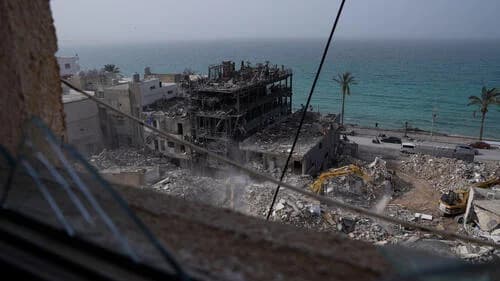
The southern Lebanese front is in its gravest phase since the 2024 war. The November 2024 ceasefire effectively collapsed on 2 March 2026, when Hezbollah fired rockets at northern Israel amid the US/Israel-Iran war, and Israel responded with a sustained air and ground campaign: according to Prime Minister Nawaf Salam, nearly 3,500 airstrikes, 407 demolitions and six razing operations since 16 April alone. Although Washington and Tehran agreed to a ceasefire on 8 April 2026, Israel kept operating in Lebanon on the grounds that 'the two fronts are separate': on 11 April Israeli strikes killed at least 18 people across the south, and on 9 June another 14 were killed in Tyre (next to a Red Cross centre), Sidon and Nabatieh. The IDF holds a strip up to 10 km deep north of the Blue Line, pushing past the Litani in places, and continued bombing areas such as Markaba and Nabatieh al-Fawqa even after the late-June agreement.
Figures on the affected population, each with its source and date.
Internally displaced
Gobierno del Líbano (más de 1 millón de desplazados desde el 2 de marzo de 2026; ~400.000 retornados a inicios de julio) · July 2026
Population facing acute food insecurity (IPC 3+, estimate)
IPC/PMA (WFP), proyección Fase 3+ abril-agosto 2026 · April 2026
Estimated fatalities
Ministerio de Salud Pública del Líbano (acumulado desde el 2 de marzo de 2026; vía Middle East Monitor) · July 2026
Who faces whom.
Every actor with what they control and what they are after, and the ties of support and hostility that bind them to the rest. The camps are not assigned by hand: they come from the alliances and enmities recorded in the profile.
Around Hezbollah
Around Lebanese state (Aoun/Salam)
Around Hezbollah
Around Lebanese state (Aoun/Salam)
Circle size shows relative influence; the blue arc, the share of territory under control. Camps are computed from the alliances and enmities declared in each profile.
No severity index: the CSI is a dated measurement and we publish it only where there is weekly monitoring. The profile explains the conflict through context, actors and sources.
Timeline
The events that changed the course of the conflict, in order and with their source.
This section will be populated with historical phases
Phase Title - Pending Development
Placeholder text for timeline context
Actors: Key actors to be identified Consequences: Consequences to be documented
Concrete signals the editorial team monitors to anticipate phase changes.
Disarmament pilot zones
ImprovingFroun, Srifa and Zawtar: if the LAF certifies and Israeli withdrawals continue, the mechanism scales; if it fails, war returns.
Hezbollah's response to the framework
StableThere is a threshold between rhetorical rejection and armed obstruction: clashes with the LAF would signal civil war.
UNIFIL succession
StableMandate expires December 2026; the successor presence design will define who verifies the south.
Returns and reconstruction
Improving400,000 returned of over a million displaced; reconstruction funding is the key social variable.
Coverage level
Open conflict · as of Jul 22, 2026
An open conflict we analyse but do not follow day to day. This profile gathers the context, actors and sources verified up to the cut-off date, and publishes no severity index: we do not add new events or recalculate the CSI unless the conflict escalates and we reactivate it. We say so plainly so you know what you are reading.
Last reviewed: Jul 22, 2026.
We publish how complete each profile is. These are the points of our editorial policy that can be checked against the data on file.
7 of 8 checks
- Conflict summary writtenDone
- Timeline with 10 dated events or morePending
- Conflict actors on fileDone
- Conflict status assignedDone
- 8 sources cited or moreDone
- Every published figure with its source and dateDone
- Geolocation on fileDone
- Historical and political context writtenDone
Four further policy points — per-claim verification and traceability, naming review and cross-review — are checked by hand and are not part of this count.
Methodology pending: This profile is in initial development. As research is completed, full documentation of data sources, analysis methods, and information limitations will be provided.
Key sources
- Al Jazeera — Hezbollah rejects Israel-Lebanon agreement as Israeli attacks hit south
- Al Jazeera — Israel kills 14 in southern Lebanon after trading fire with Iran
- Middle East Monitor — Lebanon says 400,000 displaced people have returned south as government prepares reconstruction plan
- The Times of Israel — US indicates Lebanese army deploying to 'pilot zones,' including one IDF will withdraw from
- Infobae — El Ejército libanés desplegó tropas en el sur del país tras la primera retirada israelí bajo el acuerdo trilateral
- Security Council Report — Lebanon, July 2026 Monthly Forecast
- World Food Programme — Lebanon: New IPC analysis shows conflict escalation pushing nearly a quarter of population into acute food insecurity
- UNIFIL — Líbano
- ACLED — Líbano
- International Crisis Group — Líbano
- Human Rights Watch — Líbano
- Amnesty International — Líbano
- UN OCHA — Líbano
- UNHCR — Líbano
- ReliefWeb — Líbano
- CFR Global Conflict Tracker — Líbano
IAW monitors this conflict as part of its structured early warning and analysis.
International Affairs Watch