Overview
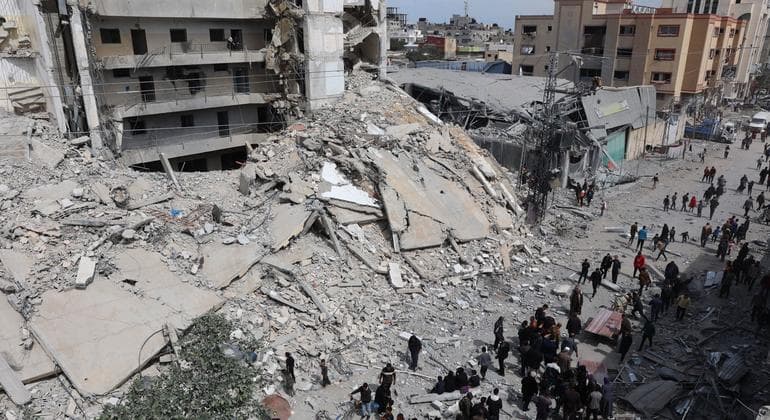
A conflict of more than seven decades over land and self-determination between Israel and the Palestinian people, whose most devastating phase opened on 7 October 2023 with the Hamas attack (some 1,200 killed and 251 hostages) and the ensuing Israeli war on Gaza: more than 73,000 Palestinians killed according to Gaza's Health Ministry, the Strip devastated — with reconstruction needs estimated at $71.4 billion — and a famine declared and later reversed in 2025.
The October 2025 ceasefire, built on Trump's 20-point plan and endorsed by Security Council resolution 2803, halted the large-scale war but left a jammed process: Hamas dissolved its government yet conditions disarmament on recognition of a Palestinian state, Israel controls most of the Strip behind the 'yellow line', the international stabilization force deploys at a trickle and reconstruction has barely begun. In the West Bank, meanwhile, settlement expansion and settler violence fuel warnings of de facto annexation eroding the viability of the two-state solution.
The Gaza ceasefire, in effect since 10 October 2025 and endorsed by UN Security Council Resolution 2803 (17 November 2025), formally holds but continues to erode. According to the Gaza Ministry of Health, as of 20 July 2026, 1,158 Palestinians had been killed and 3,756 injured since the truce began, with recurrent Israeli fire against people crossing the so-called 'yellow line'. Israel expanded territorial control beyond agreed limits: the IDF controlled 64% of the Strip by late April 2026 and Netanyahu ordered expansion to 70% on 28 May, with some 40 military outposts established, eight of them built after the ceasefire. Concerns persist over a renewed offensive ahead of Israel's 27 October 2026 elections.
Figures on the affected population, each with its source and date.
Internally displaced
Evaluación Rápida de Daños y Necesidades (RDNA) UE/ONU/Banco Mundial · April 2026
Population facing acute food insecurity (IPC 3+, estimate)
IPC (proyección dic. 2025 - abr. 2026, fase 3 o superior) · December 2025
Estimated fatalities
Ministerio de Salud de Gaza (acumulado desde octubre de 2023) · July 2026
Who faces whom.
Every actor with what they control and what they are after, and the ties of support and hostility that bind them to the rest. The camps are not assigned by hand: they come from the alliances and enmities recorded in the profile.
Around Israel (IDF)
Around Hamas
Around Israel (IDF)
Around Hamas
No declared alignment
Circle size shows relative influence; the blue arc, the share of territory under control. Camps are computed from the alliances and enmities declared in each profile.
The severity index is published only on profiles under weekly monitoring: it is a dated measurement and we do not display it where we do not recalculate it.
Timeline
The events that changed the course of the conflict, in order and with their source.
This section will be populated with historical phases
Phase Title - Pending Development
Placeholder text for timeline context
Actors: Key actors to be identified Consequences: Consequences to be documented
Concrete signals the editorial team monitors to anticipate phase changes.
Yellow-line incidents
Stable1,158 killed since the ceasefire: the tempo of Israeli fire at crossings defines whether the truce holds.
Hamas disarmament
StableGovernment dissolved but weapons conditioned on statehood recognition: the knot of the plan's phase two.
ISF deployment
ImprovingScaled to a planned 5,000 with delays; without the stabilization force there are no sustainable Israeli withdrawals.
De facto annexation in the West Bank
WorseningRising settler violence and settlement expansion; they erode the viability of any final agreement.
Coverage level
Periodic review · review overdue
This profile is reviewed once a month: the situation overview and figures are updated if they changed. Between reviews there may be relevant events not yet incorporated. We do not publish a severity index: the CSI requires the weekly monitoring this profile does not have.
Last reviewed: Jul 22, 2026.
This profile's review is overdue against the frequency we state (45 days of grace). We show it rather than hold up a promise we did not keep.
We publish how complete each profile is. These are the points of our editorial policy that can be checked against the data on file.
7 of 8 checks
- Conflict summary writtenDone
- Timeline with 10 dated events or morePending
- Conflict actors on fileDone
- Conflict status assignedDone
- 8 sources cited or moreDone
- Every published figure with its source and dateDone
- Geolocation on fileDone
- Historical and political context writtenDone
Four further policy points — per-claim verification and traceability, naming review and cross-review — are checked by hand and are not part of this count.
Methodology pending: This profile is in initial development. As research is completed, full documentation of data sources, analysis methods, and information limitations will be provided.
Key sources
- Security Council Report — The Middle East, including the Palestinian Question - July 2026 Monthly Forecast
- SANA — Gaza death toll rises to 73,283, Palestinian health authorities say
- UNISPAL / Naciones Unidas — Report: Gaza Strip Rapid Damage and Needs Assessment (EU, UN, World Bank)
- IPC — Gaza Strip: IPC Acute Food Insecurity Situation Oct-Nov 2025 and Projection Dec 2025 - Apr 2026
- Al Jazeera — Hamas must disarm, not 'disappear' from Gaza: Board of Peace's Mladenov
- El Español — Hamás disuelve su gobierno en Gaza y entrega el poder a un comité de palestinos respaldado por el plan de Trump
- elDiario.es / The Guardian — Así se ha desinflado el plan de Trump para Gaza: el gran proyecto de reconstrucción se queda en un campamento piloto
- Democracy Now! — Dozens of Israeli settlers storm Palestinian village in occupied West Bank
- UN OCHA oPt — Palestina
- UNRWA — Franja de Gaza
- ACLED — Palestina
- International Crisis Group — Israel/Palestina
- Human Rights Watch — Israel/Palestina
- Amnesty International — Israel/Palestina
- OHCHR — Palestina
- Comisión de Investigación de la ONU — Israel/Palestina
- WFP — Palestina
- UNICEF — Palestina
- CFR Global Conflict Tracker — Israel/Palestina
IAW monitors this conflict as part of its structured early warning and analysis.
International Affairs Watch