Overview
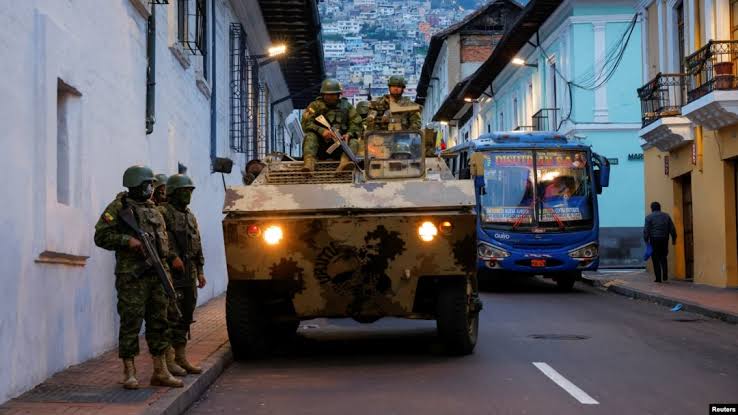
A criminal violence crisis that transformed Ecuador, in barely five years, from one of the region's safest countries into one of Latin America's most violent: the fight between local gangs tied to Mexican and Balkan cartels — Los Choneros and Los Lobos as the poles — over cocaine routes to Pacific ports multiplied homicides, prison massacres and extortion. In January 2024 President Daniel Noboa declared an 'internal armed conflict', designating the gangs as military targets.
The strategy combines successive states of emergency, military deployment, extraditions to the US — including Los Choneros leader 'Fito' Macías — and growing cooperation with Washington, which designated the main gangs as terrorist organizations. Results are mixed: the national homicide trend fell in 2026, but violence reconfigured toward new provinces such as El Oro and Manabí, and the November 2025 referendum — rejecting foreign bases and a constituent assembly — curtailed Noboa's security agenda, in a conflict with no end in sight while cocaine keeps flowing through the country.
Ecuador is in the third year of the "internal armed conflict" President Daniel Noboa declared against criminal gangs in January 2024, with a mixed picture as of July 2026: the National Police reported on June 30, 2026 an 11% reduction in violent deaths in the first half of the year (515 fewer cases than the same period of 2025, with the semester rate falling from 25.5 to 22.5 per 100,000 inhabitants), yet the country still recorded 4,154 homicides between January and June 2026, among the highest tallies in Latin America. The national improvement also masks a sharp territorial reconfiguration: El Oro province became the new epicenter of violence, with homicides up 63% (from 319 to 521 in the semester) and Machala posting the largest canton-level increase in the country, while Guayas and Los Ríos fell 23% and 28% respectively. InSight Crime warned (analysis updated February 2026) that official government figures are "unclear at best" and that kingpin captures have reshuffled rather than dismantled criminal power.
The criminal war is measured in homicides, extortion and gang territorial control.
Estimated fatalities
Policía Nacional del Ecuador / Ministerio del Interior (homicidios intencionales enero-junio 2026, vía Primicias) · June 2026
Homicides (Jan-Jun 2026)
National Police: -11% year-on-year, yet still among Latin America's highest rates (22.5/100k for the semester).
Homicide surge in El Oro
The new epicenter: from 319 to 521 in the semester, with Machala as the fastest-rising canton.
Arrests (H1 2026)
Under successive states of emergency across ten provinces and three cantons.
Violence events in Manabí (Jun)
ACLED: the deadliest month against civilians on record, driven by the Choneros-Lobos fight.
Who faces whom.
Every actor with what they control and what they are after, and the ties of support and hostility that bind them to the rest. The camps are not assigned by hand: they come from the alliances and enmities recorded in the profile.
Around Ecuadorian government (Noboa)
Around Los Choneros
Around Ecuadorian government (Noboa)
Around Los Choneros
No declared alignment
Circle size shows relative influence; the blue arc, the share of territory under control. Camps are computed from the alliances and enmities declared in each profile.
The severity index is published only on profiles under weekly monitoring: it is a dated measurement and we do not display it where we do not recalculate it.
Timeline
The events that changed the course of the conflict, in order and with their source.
This section will be populated with historical phases
Phase Title - Pending Development
Placeholder text for timeline context
Actors: Key actors to be identified Consequences: Consequences to be documented
Concrete signals the editorial team monitors to anticipate phase changes.
Territorial reconfiguration (El Oro/Manabí)
WorseningThe national improvement coexists with new epicenters; watch whether violence falls or merely moves.
Successions after extraditions
StableThe vacuums left by 'Fito', 'Topo' and 'Pipo' feed internal disputes and prison massacres.
Post-referendum institutional agenda
StableWithout a constituent assembly or foreign bases, Noboa depends on decrees and renewable emergency powers.
Cocaine flow through the ports
StableGuayaquil, Manta and Puerto López remain the prize: seizures gauge real pressure on the routes.
Coverage level
Periodic review · review overdue
This profile is reviewed once a month: the situation overview and figures are updated if they changed. Between reviews there may be relevant events not yet incorporated. We do not publish a severity index: the CSI requires the weekly monitoring this profile does not have.
Last reviewed: Jul 22, 2026.
This profile's review is overdue against the frequency we state (45 days of grace). We show it rather than hold up a promise we did not keep.
We publish how complete each profile is. These are the points of our editorial policy that can be checked against the data on file.
7 of 8 checks
- Conflict summary writtenDone
- Timeline with 10 dated events or morePending
- Conflict actors on fileDone
- Conflict status assignedDone
- 8 sources cited or moreDone
- Every published figure with its source and dateDone
- Geolocation on fileDone
- Historical and political context writtenDone
Four further policy points — per-claim verification and traceability, naming review and cross-review — are checked by hand and are not part of this count.
Methodology pending: This profile is in initial development. As research is completed, full documentation of data sources, analysis methods, and information limitations will be provided.
Key sources
- Primicias — El Oro se convierte en el epicentro de la violencia por tasa de homicidios en Ecuador; crímenes se elevaron 63% en el primer semestre
- La República (Ecuador) — Muertes violentas en Ecuador se redujeron un 11% en lo que va de 2026, dice la Policía
- ACLED — Latin America and the Caribbean Overview: July 2026 (Ecuador: gang war in Manabí and state of emergency)
- Primicias — ¿Incluye toque de queda el nuevo estado de excepción decretado en Ecuador este 16 de junio de 2026? (Decreto 423)
- Primicias — Corte declara constitucional el nuevo estado de excepción en 10 provincias y tres cantones de Ecuador
- InSight Crime — Ecuador's Official Security Claims Belie Reality
- The Rio Times — Topo Extradition: Ecuador National Court Approves Sending Choneros No.2 to US
- La Nación — Freno a Noboa: Ecuador rechazó en un referéndum el regreso de las bases militares extranjeras y sus otras propuestas
- ACLED — Ecuador
- International Crisis Group — Ecuador
- Human Rights Watch — Ecuador
- Amnesty International — Ecuador
- InSight Crime — Ecuador
- OHCHR — Ecuador
- UNHCR — Ecuador
- ReliefWeb — Ecuador
- R4V — Ecuador
IAW monitors this conflict as part of its structured early warning and analysis of Latin America.
International Affairs Watch