Graphics · Afghanistan · April–October 2025
Anatomy of an escalation
Six months of violence reconstructed from 804 events recorded by ACLED, up to the October week when the border with Pakistan became a front.
- Events
- 804
- Reported deaths
- 568
- Source
- ACLED
Scroll to begin ↓
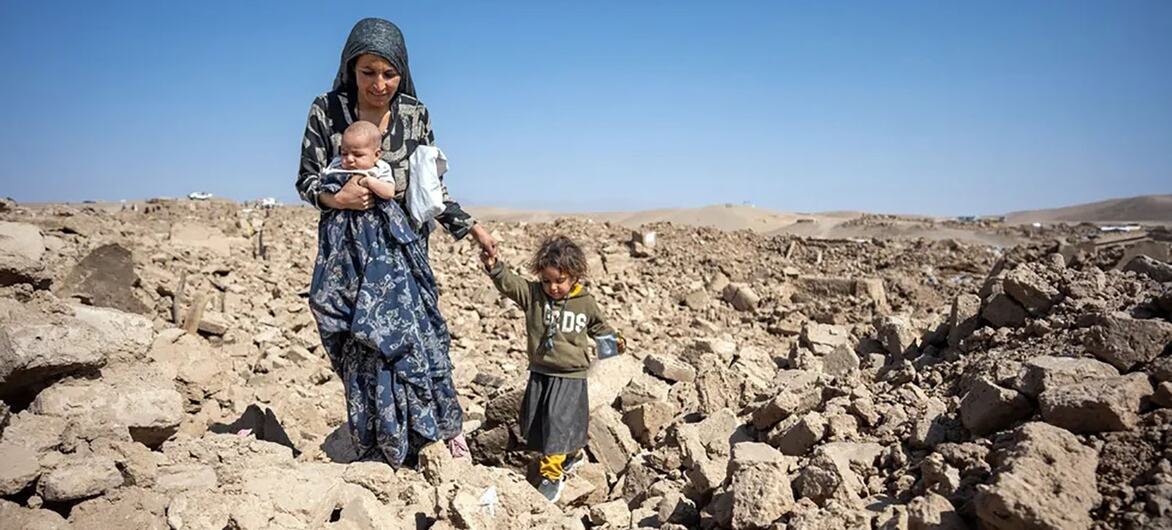
Humanitarian resources to support women and their children are diminishing in Afghanistan. © UNICEF/Mark Naftalin
0
events
0
deaths
5 April to 16 October
Every dot is an event.
Where it happened, who took part, how many died. Size is the number of reported deaths; colour, the kind of event. Keep scrolling: the dots appear in the order they happened.
- Battles
- Explosions / remote violence
- Violence against civilians
- Strategic developments
- Protests
- Riots
The rhythm
For six months the country bled at a steady rate. Then it didn’t.
Between 49 and 71 reported deaths a month from April to September. In the first sixteen days of October: 182. The last week of the series, 11–16 October, holds 162 deaths, more than any full month.
Where
Six provinces hold half of all deaths.
Kandahar (67), Kabul (57), Kunduz (54), Badakhshan (46), Paktia (40) and Baghlan (35): 299 of the 568. But they die for different reasons. Kandahar and Paktia are the border; Kunduz and Baghlan, the resistance; Kabul, the capital where the state hunts and the drones arrive.
Four Afghanistans
It is not one war. It is four.
The same 804 dots, split by who fights whom, tell stories that barely touch: a border, a resistance, a state and a street.
- 161Taliban state vs. rebel groups
- 140Taliban state vs. Pakistani forces
- 80Taliban state against civilians
- 69Militias and armed groups against civilians
- 25Internal Taliban clashes
- 21Riots
1 · The border
94 events, 169 dead. 146 of them in October.
Until August the border with Pakistan produced two to five incidents a month. In August, 16; in September, 12; in October, 50. Drones, artillery and clashes between the Taliban army and Pakistan’s Frontier Corps along 1,200 kilometres of the Durand Line.
2 · The north
The resistance is small, steady, and lives in Kunduz.
The Afghanistan Freedom Front and the National Resistance Front: 84 events, 154 dead. Checkpoint ambushes, bombs under vehicles, almost always in Kunduz, Takhar and Baghlan, sometimes in Kabul. Islamic State–Khorasan, which dominates the headlines, appears in 10 events.
3 · The state
When the target is a civilian, the perpetrator is the state seven times in ten.
251 events with civilians as the target; in 176 the actor is a Taliban government force. The General Directorate of Intelligence arrests and disappears people (53 events). The Vice and Virtue police detain barbers for shaving and women for going out without a guardian (40, mostly in Kabul and Herat). Few deaths; the pattern is disappearance.
4 · The street
People still protest. Sometimes they pay with their lives.
123 protests and riots, 30 in Kabul and 19 in Badakhshan. Unpaid workers, traders, women of the Purple Saturdays movement indoors, farmers against poppy eradication. On 30 June in Khash, Taliban special forces fired on farmers: at least 8 dead.
October
Eight days.
What follows is the week that changed the scale, day by day, with the events on the map.
9 October
Drones attributed to Pakistan strike the TTP leadership in central Kabul. Two dead. The first strike on the capital.
11 October
The Taliban response: 19 clashes in one night along the whole border, from Kunar to Helmand. 34 reported dead.
12 October
Pakistan bombs Taliban positions by drone at Spin Boldak (Kandahar) and Bahram Chah (Helmand): 11 and 10 dead. 24 for the day.
13 October
Seven young Afghan men shot dead by the Frontier Corps while trying to cross the border in Helmand.
14 October
Jaji, Paktia: the longest clash. 25 reported dead.
15 October
Spin Boldak, 39 dead: the deadliest day of the period. In Kabul another strike kills six civilians, a journalist among them.
16 October
UNAMA confirms 37 Afghan civilians killed and 425 injured in the border clashes of 11–16 October. The extraction ends there.
What remains
The dots are precise. What is missing between them cannot be seen.
ACLED records what some source reported; where nobody reported, there is no dot. Deaths are the most conservative figure available: a floor. 568 is what is verifiable, not what happened.
Source: Armed Conflict Location & Event Data (ACLED), acleddata.com, extracted 16 October 2026; events from 5 April to 16 October 2025. Deaths = most conservative reported figure. Cartography: Mapbox, OpenStreetMap. Published 17 October 2026.