Overview
An open crisis since the Taliban takeover of August 2021, following the US withdrawal and the republic's collapse. The Islamic Emirate governs without broad international recognition — only Russia formalized it in 2025 — imposes the world's most severe system of female exclusion, and faces the threat of Islamic State-Khorasan (ISKP) and low-intensity pockets of armed resistance.
Overlaid on the governance crisis is a structural humanitarian emergency — more than 20 million people need assistance amid shrinking funding — aggravated by mass forced returns from Iran and Pakistan (nearly 3 million in 2025 alone) and recurrent earthquakes. Since late 2025, the escalation with Pakistan over TTP sanctuaries has become the dominant security dynamic: cross-border strikes, closed trade crossings and hundreds of civilian casualties, with intermittent Chinese mediation and no stable de-escalation mechanism.
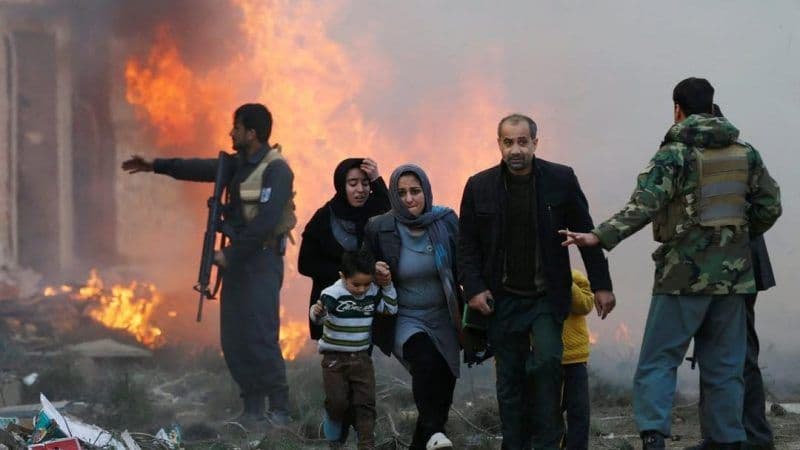
The security dynamic in April-July 2026 is dominated by escalation with Pakistan rather than by the internal insurgency. Following Pakistan's February 27, 2026 declaration of "open war" and the launch of Operation Ghazab-ul-Haq — including the March 16 airstrike on the Omid drug rehabilitation hospital in Kabul that killed at least 269 people — the Security Council recorded more than 750 civilians killed or injured by cross-border violence in January-March alone. China-mediated talks in Urumqi (April 1-7) temporarily reduced strikes, but the lull collapsed: on June 29 Pakistan struck eastern Afghan provinces (Islamabad claimed 25-29 militants killed; the Taliban reported 36 civilian deaths), on July 1 Afghan forces launched drones into Pakistani territory — four shot down according to Pakistan — and on July 8 fresh border clashes killed at least 28 civilians and injured 49 in the east. Key border crossings have remained closed since October 2025. Islamic State-Khorasan (ISKP), weakened by Taliban pressure according to International Crisis Group, retains capacity for targeted attacks: on April 10, 2026 gunmen killed at least 11 Shia civilians near a shrine in Herat. The armed resistance (NRF and allied groups) remains at a low-intensity harassment level without territorial control.
Figures on the affected population, each with its source and date.
Internally displaced
IDMC, Global Report on Internal Displacement 2026 (desplazados internos por conflicto a fin de 2025) · December 2025
Refugees / cross-border displaced
ACNUR, Portal de Datos Operacionales – Situación Afganistán · December 2025
Population facing acute food insecurity (IPC 3+, estimate)
IPC (proyección Fase 3+ abril-septiembre 2026; análisis de diciembre 2025) · December 2025
Who faces whom.
Every actor with what they control and what they are after, and the ties of support and hostility that bind them to the rest. The camps are not assigned by hand: they come from the alliances and enmities recorded in the profile.
Around Islamic Emirate (Taliban)
Around ISKP
Around Islamic Emirate (Taliban)
Around ISKP
No declared alignment
Circle size shows relative influence; the blue arc, the share of territory under control. Camps are computed from the alliances and enmities declared in each profile.
No severity index: the CSI is a dated measurement and we publish it only where there is weekly monitoring. The profile explains the conflict through context, actors and sources.
Timeline
The events that changed the course of the conflict, in order and with their source.
This section will be populated with historical phases
Phase Title - Pending Development
Placeholder text for timeline context
Actors: Key actors to be identified Consequences: Consequences to be documented
Concrete signals the editorial team monitors to anticipate phase changes.
Border escalation with Pakistan
WorseningCross-border strikes and drones after the Urumqi truce collapse; now the dominant security dynamic.
Mass forced returns
Worsening778,700 returns in 2026 (81% deportations from Iran); 2.7 million projected by year-end.
Reopening of trade crossings
StableClosed since October 2025; holding up 5,500 tonnes of aid cargo and choking the economy.
ISKP attack capability
ImprovingWeakened but with targeted attacks (Herat, April); a resurgence would change the international calculus.
Coverage level
Open conflict · as of Jul 22, 2026
An open conflict we analyse but do not follow day to day. This profile gathers the context, actors and sources verified up to the cut-off date, and publishes no severity index: we do not add new events or recalculate the CSI unless the conflict escalates and we reactivate it. We say so plainly so you know what you are reading.
Last reviewed: Jul 22, 2026.
We publish how complete each profile is. These are the points of our editorial policy that can be checked against the data on file.
7 of 8 checks
- Conflict summary writtenDone
- Timeline with 10 dated events or morePending
- Conflict actors on fileDone
- Conflict status assignedDone
- 8 sources cited or moreDone
- Every published figure with its source and dateDone
- Geolocation on fileDone
- Historical and political context writtenDone
Four further policy points — per-claim verification and traceability, naming review and cross-review — are checked by hand and are not part of this count.
Methodology pending: This profile is in initial development. As research is completed, full documentation of data sources, analysis methods, and information limitations will be provided.
Key sources
- UNHCR — Afghanistan situation – Operational Data Portal (returns and refugee figures)
- Security Council Report — Afghanistan, June 2026 Monthly Forecast
- Al Jazeera — After Afghanistan fires drones into Pakistan, what's next?
- IPC — Afghanistan: Recent improvements threatened as 17.4 million people face high levels of acute food insecurity
- IDMC — 2026 Global Report on Internal Displacement
- ACAPS — Afghanistan country analysis: conflict, displacement and humanitarian needs
- UNAMA — UN Security Council extends UNAMA mandate for one year (Resolution 2822)
- OHCHR — Türk: States must halt involuntary returns to Afghanistan
- ACLED — Afganistán
- UNAMA — Afganistán
- UN OCHA — Afganistán
- ReliefWeb — Afganistán
- International Crisis Group — Afganistán
- Human Rights Watch — Afganistán
- Amnesty International — Afganistán
- UNHCR — Afganistán
- IOM DTM — Afganistán
- IPC — Afganistán
- WFP — Afganistán
IAW monitors this conflict as part of its structured early warning and analysis of Central Asia.
International Affairs Watch