IAWPolicy brief · No. 01 · 12 November 2026
Sudan’s third phase
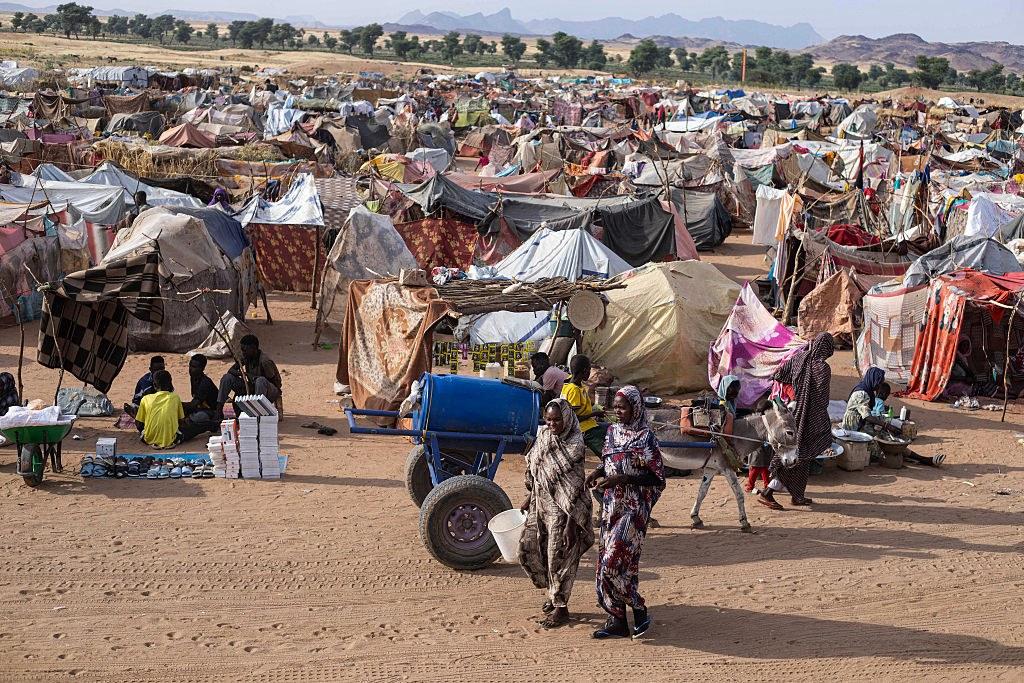
The war has moved into the air and across borders while drought closes in on the west. This brief sets out where the conflict stands, what is driving it and what the coming months will decide.
- 33.7 m
- people in need of humanitarian assistance
- OCHA, 2026 response plan
- 19.5 m
- people facing acute food insecurity
- IPC, May 2026
- 8.6 m
- internally displaced; 5.2 m have returned
- IOM, Sep and Nov 2026
- 47%
- of the US$2.9 bn response plan funded
- UNHCR and IOM, 6 Nov 2026
Key judgments
- 1
The ground war has turned in the army’s favour, but not decisively.
The Sudanese Armed Forces (SAF) broke the encirclement of El Obeid before the rains and are advancing into West Kordofan. The Rapid Support Forces (RSF) still hold almost all of Darfur and have opened a second front in Blue Nile.
- 2
Drones are now the principal source of civilian harm.
The UN Human Rights Office documented at least 306 deaths from drone strikes in the first three weeks of October. Both parties strike markets, displacement sites and power stations, at ranges of up to 1,500 km.
- 3
The conflict is regionalising faster than it is being mediated.
Sudan and Ethiopia expelled each other’s diplomats on 4 November. A strike near Abyei drew a formal protest from South Sudan, and a drone strike killed four people in eastern Chad.
- 4
Famine risk now has a second driver.
An El Niño drought covers roughly half the country, on top of siege, displacement and a response plan that is less than half funded. Agencies report empty warehouses ahead of the lean season.
- 5
Diplomacy is stalled on sequencing rather than substance.
All three positions accept a truce in principle and differ on what must come first. The Security Council sanctions regime expires on 11 December unless renewed.
01
Where the war stands
Three years and seven months into the war, the map has hardened into an east–west division with Kordofan as its hinge. Control is shown by state and is approximate: lines are fluid and large desert areas hold no permanent garrison.
1Kordofan
Coordinated SAF offensives collapsed the RSF encirclement of El Obeid, ending a stalemate of more than eighteen months, and seized RSF weapons and drone depots at Geberat Al Shaikh. The army took Sodari on 25 September, reported the capture of Al-Mazroub in early October and says it retook Iyal Bakhit, in West Kordofan, on 7 November. The RSF holds most of West Kordofan, including En Nahud and the Heglig oilfield.
2Blue Nile
The RSF and its ally, the SPLM-N faction led by Abdelaziz al-Hilu, have attacked the state since January. Kurmuk has changed hands at least twice this year. The RSF and allied militias reportedly captured the Sali base on 3 November, and a suspected RSF drone strike near Ed Damazin killed nine people on 10 November. The army holds Ed Damazin, Roseires and the north of the state.
3Darfur
The RSF has controlled almost all of Darfur since El Fasher fell on 27 October 2025 after an eighteen-month siege. Army-allied Joint Force units hold pockets in the north and west; the SLM faction of Abdel Wahid Nour holds parts of Jebel Marra, including Tawila, and declares neutrality. Nyala is the seat of the RSF-led parallel administration sworn in in August 2025, which has not been recognised internationally, and a regular target of army air strikes.
Assessment
ACLED analysts described the Kordofan breakthrough as the start of a third phase of the war and judged it unlikely that the RSF could hold against offensives on three parallel fronts. The RSF has answered by trading ground for reach: long-range strikes on the army’s rear and a new front in the south-east. IAW’s reading is that neither side is positioned to force a decision before the 2027 rains, and that each month of attrition consolidates two separate administrations.
02
The war moves into the air
Aerial attack has shifted from the army’s manned aircraft to drones used by both sides. IAW’s compilation of ACLED records shows the change in the eighteen months before the current escalation.
Air and drone strike events recorded in Sudan, per month
The 2026 escalation
The UN counted nearly 700 civilians killed by drone strikes between January and mid-April, more than 1,000 by the end of May and at least 306 in the first three weeks of October alone. UNICEF reports that two in three child casualties this year were caused by armed drones.
Two campaigns
Since 22 October the Critical Threats Project has recorded 21 sets of RSF strikes on fuel depots and power stations in army-held areas, among them Ed Damazin, Wad Madani, Rabak, Sinja, Omdurman and Khartoum. Since mid-October it has recorded ten sets of army strikes on markets in RSF-held towns, including Nyala, Ed Daein and El Fasher. A strike on Amiet market, north of Abyei, on 19 October reportedly killed between 153 and 226 people.
Why it matters
Range dissolves the rear: places that were safe are now within reach. Strikes on power stations stop water pumping, treatment and irrigation, turning a military tactic into a humanitarian driver. UNICEF counted up to fifteen power stations hit in October; the UN could not establish who was responsible for those strikes, which complicates any monitoring arrangement.
03
A regional war, a narrowing food margin
The war’s supply lines and its consequences now run through at least five neighbouring states. Disputes that were managed quietly have become formal.
1Asosa, Ethiopia. Sudan alleges RSF drones are launched from Ethiopian territory. Consulates closed on 4 November.
2Abyei and Heglig. Amiet market strike, 19 October. Juba oversees an oil revenue arrangement between the parties at Heglig.
3Eastern Chad. Drone strike in Wadi Fira province killed four people in October.
4Libyan corridor. Desert route to the north-west held by the RSF.
Ethiopia
On 1 November Sudan complained to the Security Council and the African Union, alleging 70 RSF drone attacks launched from Ethiopia between February and October, 28 of them in October. Ethiopia rejects the allegation and accuses Khartoum of hosting Tigrayan fighters. An adviser to Sudan’s Sovereignty Council said the government is making every effort to avoid open war.
South Sudan and Chad
Juba summoned Sudan’s ambassador after the Amiet strike; President Salva Kiir said Abyei must not become a theatre of the conflict. RSF supply lines run through both countries, and both host large refugee populations.
External backers
The United Arab Emirates is widely reported to be the RSF’s principal backer, which it denies. Egypt is the army’s closest regional supporter and Iran has supplied it with drones. The mediating Quad therefore includes reported backers of both sides.
Drought on top of siege
The IPC warned on 12 October of growing famine risk across Greater Darfur and Greater Kordofan. Poor vegetation growth affects 64% of cropland in North Darfur and about half in South Darfur, West Kordofan and South Kordofan; two displacement camps in South Darfur recorded acute malnutrition above famine thresholds. Fourteen areas were already classified at risk of famine in May, and 37% of health facilities no longer function. Food prices remain high at a time of year when they normally ease after the harvest, and the Sudanese pound lost nearly half its value in army-held areas between early summer and September. IOM reports that its warehouses are empty.
- 64%
- of cropland in North Darfur with poor vegetation growth
- IPC, Oct 2026
- 14
- areas classified at risk of famine
- IPC, May 2026
- 825,000
- children under five expected to suffer severe acute malnutrition in 2026
- UNICEF
- 1 in 10
- people in need whom agencies are able to assist
- UNHCR and IOM, Nov 2026
04
Diplomacy and outlook
The Quad of the United States, Saudi Arabia, the United Arab Emirates and Egypt proposes a ninety-day humanitarian truce, then a ceasefire and a nine-month transition. Twenty-seven countries met in Geneva on 21 October with neither belligerent present. General Abdel Fattah al-Burhan had said on 6 October that there would be no negotiation with the RSF.
The sequencing dispute
| First | Then | Finally | |
|---|---|---|---|
| Washington and the Quad | Truce without preconditions | Talks on a permanent ceasefire | Transfer to a civilian government |
| The army | RSF withdrawal from the cities it holds, under international supervision | Cantonment and disarmament | Sudanese dialogue and elections |
| The RSF | Truce under international monitoring | No prior withdrawal or disarmament | Broad political settlement |
Scenarios to mid-2027
Qualitative judgments by IAW. They are not forecasts.
Scenario A · Most likely
Attrition and a wider air war
No truce. The army grinds west through Kordofan; the RSF sustains strikes on infrastructure and pressure in Blue Nile. Famine is classified in parts of Darfur and Kordofan during the lean season.
Indicators. Fall of En Nahud; frequency of power-station strikes; next IPC analysis.
Scenario B · Possible
A conditional truce
External pressure produces a time-bound humanitarian truce built on monitored arrangements short of full withdrawal. Violations remain frequent, but access improves in Kordofan and Darfur.
Indicators. Direct or proximity talks; agreed monitoring of drone launches; reopening of supply routes to El Obeid and Kadugli.
Scenario C · Less likely, highest impact
Regional escalation
An incident on the Ethiopian border or around Abyei becomes a confrontation between states. Supply corridors and launch sites outside Sudan become targets.
Indicators. Cross-border strikes; troop movements near Asosa or Gedaref; breakdown of the Heglig arrangement.
Decision points
- 11 Dec 2026
- The Darfur sanctions regime and arms embargo expire unless renewed (resolution 2830). A US proposal for a nationwide embargo was withdrawn in October amid Russian and Chinese opposition.
- Dec–Feb
- Harvest results in Darfur and Kordofan and the next IPC analysis; the May analysis expected deterioration through early 2027.
- 15 Apr 2027
- Fourth anniversary of the war; the lean season follows from May.
What follows from the evidence
- A truce drawn only along ground lines would not address the main source of civilian harm. The relevant variables are drone supply, launch territory and attribution.
- For the humanitarian response, timing matters more than volume. Pipelines are empty now, before the months in which need peaks.
- The mediation tracks coordinate with one another, but neither has both belligerents at the table, and the disputes with Ethiopia and South Sudan have no dedicated channel.
Method and limits. This brief synthesises open sources and IAW’s compilation of ACLED event data. Claims by the parties are attributed and have not been independently verified. No verified death toll exists: published estimates range from about 150,000 to 400,000. IAW is independent of every party to the conflict and does not issue recommendations to governments; the brief offers findings, scenarios and indicators.
Sources. ACLED, expert comment, 13 Aug 2026 · Critical Threats Project, Africa File, 5 Nov 2026 · OHCHR, statement of the High Commissioner, 23 Oct 2026 · UNICEF briefing, UN News, 10 Nov 2026 · UNHCR and IOM joint statement, UN News, 6 Nov 2026 · IOM Displacement Tracking Matrix, 21 Sep 2026 · IPC alert, 12 Oct 2026, and analysis of May 2026 · OCHA, Sudan Humanitarian Needs and Response Plan 2026 · Security Council resolution 2830 (2026) · UN News, 21 Oct 2026 · The National, 23 Oct 2026 · Reuters, AFP and Al Jazeera, 2–5 Nov 2026 · CFR Global Conflict Tracker, 10 Nov 2026 · Sudan Tribune, 8–10 Nov 2026 · Arabic Post, 12 Oct 2026 · Al Jazeera, 1 and 4 Oct 2026 · UNHCR Refugee Data Finder, end-2025 · CSIS, The Sudan War in 10 Charts, 2026.
By Ezequiel Emanuele · International Affairs Watch