International Affairs Watch · Visual investigation
HaitiLife under siege
The human anatomy of a protracted crisis
Violence does not only destroy lives. It also transforms the conditions under which millions of people try to live them.
Opening
A country where surviving has become a daily task
In mid-September 2026, at the start of the school year, UNICEF’s representative in Haiti, Geetanjali Narayan, visited a classroom in Port-au-Prince and asked the pupils what they needed from the organisation. According to the account published by the United Nations news service, the children did not talk about school supplies or food. They asked her to stop the armed gangs.1 The day after classes began, she said, two girls were kidnapped on their way to school.
The episode says a good deal about the state of the country. That a group of primary school pupils should raise a public security problem with an international official, and do so in the manner of someone asking for something concrete and urgent, shows how far violence has ceased to be an exceptional event and become the framework within which daily life is organised. Going to class, buying rice, reaching an emergency room or deciding where to sleep are today, for a large share of Haitians, decisions taken by weighing a risk.
 IAW
The scale of the problem
The data available as of November 2026 show that the crisis now reaches far beyond the neighbourhoods of the capital where it began. The International Organization for Migration (IOM) records close to 1.49 million internally displaced people, around 12% of the population.2 The Integrated Food Security Phase Classification places 5.94 million people, 53% of the population analysed, in crisis or emergency levels of food insecurity.3 The United Nations humanitarian plan estimates that 6.4 million inhabitants, out of a total of 11.9 million, need assistance.4 And the United Nations Integrated Office in Haiti (BINUH) documented, between January and September of this year alone, at least 4,217 people killed and 1,860 injured in incidents of armed violence.567
Read separately, those figures explain little. What makes the situation intelligible is the relationship between them. A family that flees its neighbourhood loses, along with the house, the market stall and the children’s school. Without that income, meals are cut back, and malnutrition appears among the youngest just when the local health centre has stopped operating. Each of these processes aggravates the next, so that the deterioration advances as a chain and reaches households that were never near a clash.
A different unit of analysis
The discussion about Haiti tends to be organised around three questions: who governs, what territory the gangs control and which international force might contain them. They are pertinent questions, and 2026 has given them plenty of material. On 7 February the Transitional Presidential Council was dissolved and executive power passed to Prime Minister Alix Didier Fils-Aimé; in parallel, the still partial deployment began of the Gang Suppression Force authorised by the Security Council.89
This study is concerned with something else. Its subject is the people who live under the decisions of the state, the gangs and the foreign missions, and the question that organises it is how the life of a society changes when violence ceases to be an extraordinary event and comes to condition almost every everyday decision.
Answering it requires looking at what security statistics leave out. A homicide is counted once, whereas the years of schooling a child loses weigh on the whole of his or her adult life. A clash may last a few hours, and the displacement it causes, several years. The usual indicators of a conflict (deaths, injuries, territory) record the moment of impact, but say very little about its duration and about the way it spreads. Hence the eight chapters that follow address displacement, hunger, childhood, the situation of women, health, the exposure of civilians to armed violence and security operations, the household economy and the long-term consequences.
Three caveats
The first is territorial. Haiti is not a homogeneous country, and national averages conceal decisive differences. Of the victims recorded by BINUH in the third quarter of 2026, 85% were in the Port-au-Prince metropolitan area,5 yet 79% of displaced people live in the provinces.10 The violence is concentrated in the capital and its costs are spread across the rest of the territory, which is why transferring the diagnosis of one area to the other leads to mistaken conclusions.
The second concerns the quality of the data. Almost all the figures cited are documented minimums. The agencies that produce them warn that restricted access to gang-controlled areas, fear of reporting and the fragility of administrative records lead to an underestimate of the real magnitude of events. The methodological annex sets out the scope of each source.
The third has to do with the approach. It would be a mistake to describe Haitians solely as victims. Of those displaced, 84% are not in camps but lodged in other families’ homes,10 and it is teachers, nurses, neighbourhood committees and women’s organisations who keep running the services the state no longer provides. That capacity to respond is part of the picture and is documented in every chapter.
The account begins with the decision on which almost all the others depend: the decision to leave one’s own home.
Chapter 1
Displacement: losing a home, losing the life one knew
Displacement has ceased to be a temporary response to an attack and has become a prolonged condition of life that reorganises families, incomes and entire communities.
From a neighbourhood phenomenon to a national one
In September 2024, IOM counted 702,973 displaced people.11 A year later, in September 2025, round 11 of the DTM recorded 1,412,199.12 In May 2026 the figure reached 1,466,862 and, in August, 1.49 million.210 The displaced population doubled in two years and, although the pace of growth eased during 2026 (1% between rounds 12 and 13 and 2% between rounds 13 and 14), the total has not fallen in any measurement.
Visualisation 01
The map of displacement
The most significant change is not one of volume but of geography. Until 2023 displacement was almost exclusively a phenomenon of the Port-au-Prince metropolitan area. The expansion of armed groups towards Artibonite and the Centre department changed the map. Between June and September 2025, the displaced population hosted in Centre rose from 147,230 to 199,258 people, largely through preventive displacement after the attacks around Mirebalais and Lascahobas; in Artibonite it rose from 92,304 to 121,896 after the attacks in La Chapelle, Dessalines, Verrettes and Petite-Rivière.12 In round 14, Artibonite again recorded the largest increase in the country (+16%), and 26 of the 55 displacement sites created in that period opened there.2
In May 2026 the violence in Cité Soleil displaced more than 18,000 people in a few days and pushed the displaced population within the capital above 300,000 for the first time.13 Weeks earlier, armed attacks in the Sud-Est department (until then regarded as a place of refuge) had driven out more than 5,000 people.13 The point is significant: the places people fled to are beginning to be places people flee from.
Three ways of leaving
The records distinguish, though not always with separate figures, three dynamics. Mass displacement follows an attack: entire neighbourhoods empty within hours, as happened in Kenscoff on 23 August 2026, when at least 4,000 people left the area, or in Gros-Morne on 28 September, with more than 5,000.5 Preventive displacement is a family matter and a silent one: households that leave before the violence arrives, on seeing the neighbouring locality fall. Individual or fragmented displacement separates the members of a single household: adolescents are sent to relatives in the provinces to keep them away from recruitment, while an adult stays behind to look after the house or the market stall. In the second quarter of 2026 alone, ten major incidents of armed violence displaced 50,867 people, 19% more than in the previous quarter.14 To this must be added secondary displacement: families that had already fled once and must do so again.
 IAW
Two regimes of shelter
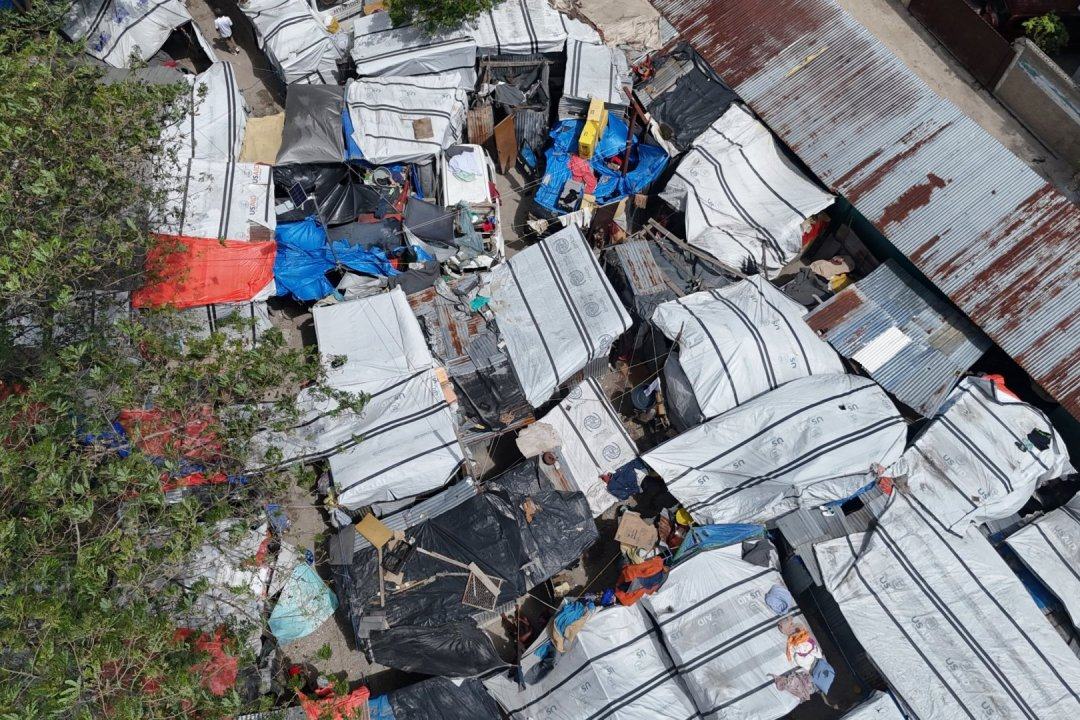
The country shelters its displaced people in two very different ways. In the provinces, 98% live outside collective sites, in the homes of relatives or acquaintances; the 150 provincial sites host barely 19,228 people, an average of 128 per site. In the capital the opposite holds: 69% live in spontaneous sites (112 sites with 213,168 people, an average of 1,903 per site), set up in schools, churches, public buildings and vacant lots.10
Conditions in the sites are precarious on almost every indicator. The Camp Coordination and Camp Management Cluster reported an average of one latrine for every 315 people, 40% of sites with no health service at all and 18% of sites where no child attends school.15 In October 2025, only 91 of 238 sites (38%) had a site manager.16 Overcrowding eliminates privacy and multiplies the risks for women and girls, as chapter 4 examines. A Mercy Corps study in five sites in Port-au-Prince (based on 114 surveys, and therefore indicative rather than representative) found that only 4.4% of those consulted felt safe, and described the sites as places “of survival, not of safety”.17
 IAW
The provincial regime is less visible and no less fragile. That four out of five displaced people live with host families means that the main humanitarian actor in the country is Haitian households themselves, many of them poor. Of the displaced population, 43% is concentrated in just ten of the 140 communes.10 In Cap-Haïtien, whose population was estimated at 300,000 in 2024, IOM had recorded 50,648 displaced people by May 2026.18 Those same communities also bear the burden of forced returns: more than 110,000 people were returned to the country between January and early June 2026 according to IOM,13 and the Support Group for Returnees and Refugees (GARR) counted 194,465 deportations from the Dominican Republic between January and August.19
Who they are
More than half of displaced people are women and girls,13 and minors account for 52% of the total.5 UNICEF estimated the number of displaced children at 755,000 in the first quarter of 2026.20 Field reports repeatedly identify pregnant women, child-headed households, children separated from their families and people with disabilities among the groups that flee.21 No up-to-date, disaggregated quantitative series were found on older people and people with disabilities; it is an information gap of consequence for the humanitarian response.
Returning is not recovering
Round 14 recorded 171,203 returnees, 3% more than the previous round, concentrated in the metropolitan area (+70%) and in Centre (+29%).2 IOM describes those returns as “largely precarious”: in Centre, a growing share is heading to communes where security remains fragile, such as Mirebalais and Saut-d’Eau. A specific study in Bas Delmas and the upper part of Port-au-Prince identified 19,949 returnees (55% women, 28% children); 68% of households expressed their intention to stay, but conditional on three factors: security, the rehabilitation of housing and infrastructure, and access to livelihoods.22
Four out of five displaced people live in other families’ homes. The main humanitarian actor in Haiti is Haitian households.
What displacement undoes
Prolonged displacement alters three structures. The family: households are divided between those who flee and those who stay, and women frequently take on the headship of extended households. The community: neighbours who shared a savings association, a church or a water committee are scattered across different communes, and with them go the informal credit and mutual aid that sustained the popular economy. The economy: those who sold in a market lose their customers, their goods and their stall; those who farmed lose access to their plot. FEWS NET classifies displaced people in sites in the metropolitan area in the emergency phase of food insecurity precisely because of the loss of livelihoods and the lack of income opportunities.23
The psychological cost is beginning to be measured. A cross-sectional survey of 1,545 adults displaced by violence, published in 2026, found that around two thirds showed severe psychological distress, with higher levels among women and among those living in rural areas.24
Losing one’s home almost always means losing the means of earning one’s food. That relationship is the subject of the next chapter.
Chapter 2
Hunger: when getting food becomes a risk
Haiti does not lack food in absolute terms: what is lacking is the possibility of producing it, transporting it, reaching it and paying for it. Violence acts on each of those links.
More than half the population
The Integrated Food Security Phase Classification (IPC) analysis published in late October 2026 concludes that 5.94 million people, 53% of the population analysed, are in Phase 3 (crisis) or above between September 2026 and February 2027. Of these, 1.8 million (16%) are in Phase 4 (emergency), concentrated in areas affected by insecurity, displacement and economic marginalisation; thirty units of analysis were classified in that phase.325 The projection for March–June 2027 anticipates 6.35 million people (57%) in Phase 3 or above, with close to 2 million in emergency, and foresees deterioration in areas of Artibonite, Sud-Est and Nord-Ouest.3
Visualisation 03
The food crisis in figures
The trajectory is consistent. There were 4.35 million between August 2023 and February 2024; 5.4 million a year later; 5.7 million in September 2025; 5.83 million in the March–June 2026 update.26272829 The March 2026 analysis recorded localised improvements attributable to emergency food assistance, which confirms two things: that aid works where it arrives, and that the situation depends on it.26
How violence produces hunger
Food security rests on three pillars: availability, access and stability. Armed violence affects all three.
Availability. The expansion of armed groups towards Artibonite, the country’s main rice-growing area, interrupts production: farmers abandon plots, cannot obtain inputs or lose the harvest. In the March 2026 update, 55% of the population of the Artibonite rice-growing zone was in Phase 3 or above.30 The World Bank estimated a 4.8% contraction in agriculture during fiscal year 2025.31 Climate shocks compound this: Hurricane Melissa damaged crops in the south in late October 2025, and El Niño is affecting the current season.3231
Access. Armed groups control most of the routes in and out of the capital.33 Every lorry carrying food pays illegal tolls or must take detours, and that cost is passed on to the final price. Access is also physical: reaching the market means crossing areas of fighting, and the women who sell (food retail is predominantly female) are exposed to robbery, extortion and sexual violence on the way. The title of this chapter is literal.
Stability. Supply becomes unpredictable. On 2 April 2026 the Government announced a 37% increase in the price of diesel and a 29% increase in the price of petrol, with an immediate effect on the transport of goods.34 FEWS NET describes purchasing power as “severely eroded” among poor households, particularly in urban centres, where dependence on the market is greater.23
 IAW
The price of the food basket
Market monitoring by the World Food Programme (WFP) put the cost of the national food basket at 26,387 gourdes for a family of five in April 2025, with higher values in Sud and Centre.35 No comparable and verifiable series was found for 2026, so the figure should be read as an order-of-magnitude reference and not as a current value. What can be stated, on the basis of the World Bank’s inflation series, is that the average general price level in fiscal year 2026 is equivalent to some 2.8 times that of 2022 (own calculation; see chapter 7).
Child malnutrition
The IPC acute malnutrition analysis released in September 2026 estimates that 253,725 children aged 6 to 59 months will suffer acute malnutrition between June 2026 and May 2027. Of these, 93,873 will present the severe form, which can be fatal without timely treatment, and 159,852 the moderate form. In addition, 25,750 pregnant and breastfeeding women will require nutritional support. Between December 2026 and May 2027, 29 of the 140 communes would reach the “serious” phase, and two (Cité Soleil and Cabaret) the “critical” phase.36
Acute malnutrition in the first five years of life raises the risk of death from common illnesses and, when it becomes chronic, compromises physical and cognitive development in a largely irreversible way. In pregnant women it raises the risk of obstetric complications and of low birth weight. Today’s hunger thus becomes a disadvantage that will accompany a generation.
Two measurements, two methods
For February–September 2026, FEWS NET estimated between 3 and 3.5 million people in need of food assistance,23 against the IPC’s 5.8 to 5.9 million. The difference does not amount to a contradiction: FEWS NET carries out its own scenario analysis, compatible with the IPC scale but not subject to the national technical consensus coordinated by the National Food Security Coordination (CNSA), and applies different assumptions about population and assistance. Both sources agree on the substance: widespread crisis and emergency, and displaced people in the capital in emergency. This investigation takes the IPC as its main reference because it is the standard adopted by the Government and the humanitarian system.
Dependence on aid, and its limit
The 2026 humanitarian plan requested 880 million dollars to assist 4.2 million people; by mid-October it was 49% funded.437 The IPC warns that assistance is insufficient in the face of growing needs.32 Dependence on aid is not a choice made by households: it is the result of having lost the plot, the stall or the road.
Those who pay that cost first are children. The next chapter examines what it means to grow up in these conditions.
Chapter 3
An interrupted generation: growing up amid violence
Haitian children are affected twice: directly, as victims and as recruits of the armed groups, and indirectly, through the collapse of the schooling, health care and food that were meant to protect them.
The scale of the problem
UNICEF estimates that 2.8 million children need humanitarian assistance in 2026.38 Minors make up slightly more than half of the displaced population: some 755,000 at the start of the year.20 To order the analysis, it helps to separate two kinds of harm that are often confused.
Recruited
The recruitment and use of children by armed groups rose by around 200% in 2025, according to UNICEF.39 The organisation’s mid-year report records 892 cases against 302 the previous year.38 The agency itself estimates that between 30% and 50% of the members of armed groups are minors.40 UNICEF describes the routes of entry: children forced to join in order to support their families or after receiving direct threats, and others who, separated from their homes, turn to the armed group as a means of survival and protection.39
Recruitment turns children into targets of security operations. In the third quarter of 2026, BINUH documented the deaths of 32 boys aged between 14 and 16, recruited by a gang, during exchanges of fire with security forces in Gressier.5 International law regards these minors, first and foremost, as victims. Since the signing of the Handover Protocol in January 2024, UNICEF and its partners have verified and assisted more than 500 children associated with armed groups with protection and reintegration services;39 the 2026 target was doubled, from 400 to 800, because of the rise in cases.40 At the end of September 2026 there were 236 boys and 19 girls in detention.5
Visualisation 04
A generation without school
Killed, injured, kidnapped
The MRM verified 620 cases of children killed or maimed in 2025, against 351 in 2024.38 In the third quarter of 2026, BINUH counted 59 boys and 19 girls among those killed; minors accounted for 6% of all victims and 10% of people kidnapped.5 In Kenscoff, two attacks in July and August left at least 105 residents dead, 19 of them children.5
Attacks with explosive drones added a specific source of risk. Human Rights Watch documented the deaths of 17 children in drone operations between 1 March 2025 and 21 January 2026.41 BINUH recorded five children among drone victims in the first quarter of 2026, six in the second and two in the third.567 Chapter 6 examines the matter in detail.
Sexual violence against girls and adolescents
Between January and May 2026, girls accounted for 11% of the survivors of gender-based violence recorded by the Protection Cluster.38 In the third quarter, 96 of the 151 reports of sexual violence received by the police involved minors, and BINUH documented cases of victims as young as eight.5 Three adolescents aged between 15 and 17 became pregnant as a result of rapes recorded in that period.5
The school that does not open
During the 2024–2025 school year, 1,606 schools remained closed because of insecurity, affecting some 243,000 pupils and 7,500 teachers; it is the most recent figure published by UNICEF.401 Schools close for three different reasons that should not be conflated: because they were attacked or destroyed, because they were left in inaccessible areas, or because they house displaced families. In the last case, the same building resolves one emergency (shelter) at the expense of another (education).
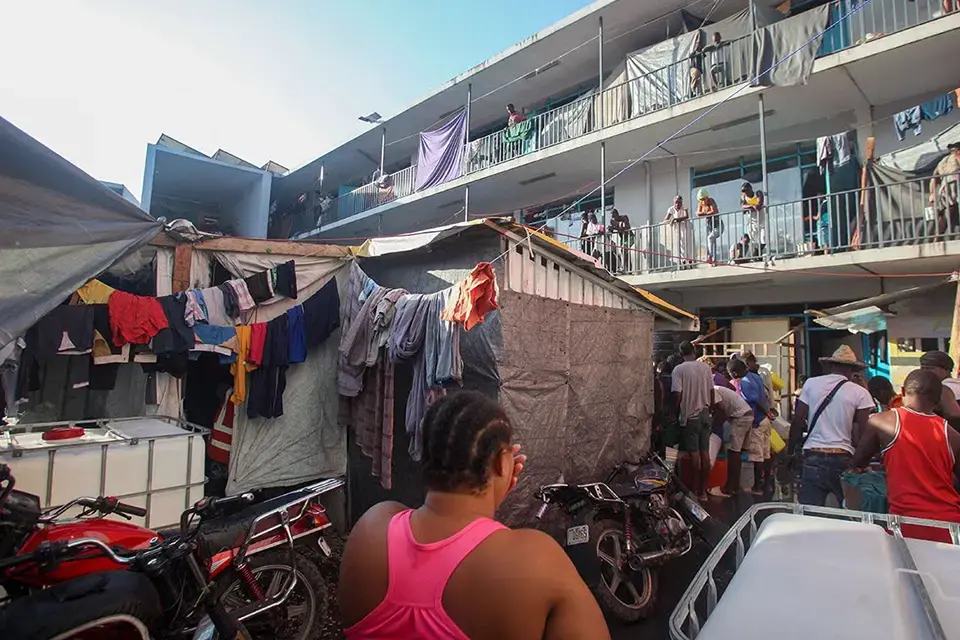
Even where the school is operating, getting to it is a risk. Children must cross areas controlled by armed groups, exposed to crossfire and to recruitment.1 For displaced children there are, in addition, the loss of documents, the impossibility of paying fees or for a uniform (most schooling in Haiti is private) and the saturation of schools in host communities. In 18% of displacement sites, no child attends class.15
The same building resolves one emergency, shelter, at the expense of another: education.
This investigation found no up-to-date UNESCO data on enrolment, drop-out or learning in Haiti for 2025–2026; the absence of recent national education statistics is in itself an indicator of the state of the system. Nor is there a consolidated and verifiable figure for children out of school across the country, so no estimate of our own is offered here.
 IAW
Body and mind
The acute malnutrition projected for more than 250,000 children under five (chapter 2) is compounded by the interruption of child health services. In 2025 UNICEF warned that more than half of health facilities lacked the equipment and medicines to treat paediatric emergencies.42 The Health Cluster reported suspected cases of diphtheria, a vaccine-preventable disease, in 2026.14 The same bulletin documents a significant counter-example: between 7 and 12 June 2026, 448,449 children aged 6 to 15 were vaccinated against diphtheria and tetanus in 2,249 schools.14 Where the school opens, it also works as a health platform.
Information on children’s mental health is scarce. There are no representative prevalence studies; what is known comes from psychosocial support programmes and from the observations of teachers and health workers. Prolonged exposure to violence, loss and uprooting during childhood is associated, in the specialist literature, with difficulties in learning, in emotional regulation and in health in adult life. The testimony of a displaced father gathered by the United Nations also points to the direction of the response: for these children, school operates as a form of therapy.1
The intergenerational bill
The effects described do not end with childhood. A child who loses two or three years of schooling rarely recovers them; each year lost reduces future earnings and, with them, the capacity to sustain the education of his or her own children. An adolescent girl who leaves school faces a higher likelihood of early pregnancy and economic dependence. A child malnourished in the early years learns less even when able to attend. And a recruited adolescent is marked by the violence he inflicted and suffered, and by the stigma that makes returning to the community difficult.
The sum of these processes constitutes a mechanism of transmission: the crisis of 2021–2026 is inscribed in the biography of those who are today between zero and eighteen years old, and it will condition the country’s economy, public health and civic life for decades to come. Amnesty International summarised it in its February 2025 report on Haitian children: recruitment, sexual violence, killings and the deprivation of education and health operate simultaneously on the same children.43
Within that generation, girls and women face an additional risk that calls for an examination of its own.
Chapter 4
Surviving as a woman: violence, motherhood and lack of protection
Sexual violence is not a side effect of the Haitian conflict but one of its instruments. It coincides with the collapse of the services that ought to care for survivors and for pregnant women.
What is recorded
Between January and September 2025, 7,472 cases of gender-based violence were reported in Haiti, an average of 27 a day;16 between January and November of that year, the Protection Cluster counted some 8,100.38 Between January and May 2026, 2,888 cases were recorded, a level UNICEF describes as similar to that of the previous year. Adult women accounted for 84% of survivors and girls for 11%; approximately 68% of cases were rapes.38
BINUH’s Human Rights Service, which applies a different verification method, documented in the third quarter of 2026 a total of 344 victims of rape committed in that period, aged between 8 and 75. Of these, 77% were gang rapes and 96% occurred in the Ouest department. At least five victims were killed after the assault.5
Visualisation 05
Surviving as a woman
An instrument of control
The predominance of gang rapes committed by members of armed groups indicates a pattern, not a sum of isolated events. In 2025, 65% of recorded rape cases were gang rapes attributed to armed groups.40 BINUH describes sexual violence as a means used by the gangs to subjugate the population living in the areas under their control.44 It operates as punishment for those who live in a rival group’s territory, as a mechanism of extortion, as reprisal against families and as a demonstration of dominance over a neighbourhood. Its effect extends beyond the direct victim: it restricts the mobility of every woman in the area, who stop going to the market, to work or to school.
The risk inside the shelter
More than half of displaced people are women and girls.13 The collective sites in the capital, conceived as a refuge, reproduce the risk: overcrowding, no lighting, latrines shared by hundreds of people with no separation by sex, and a lack of reporting mechanisms. In the Mercy Corps study already cited, three in ten women surveyed (30.7%) said they had suffered physical or sexual violence inside the site, and two thirds pointed to the absence of mechanisms to report it; women avoided moving about at night and using the latrines.17 The size of the sample does not allow generalisation, but the finding is consistent with agency reports.
Deportation adds another route of exposure. In March 2026 alone, GARR recorded 121 pregnant women and 246 breastfeeding mothers among those forcibly returned from the Dominican Republic.45
After the assault
Clinical care after rape is time-sensitive: HIV prophylaxis must begin within 72 hours and emergency contraception within 120. Meeting those deadlines requires a service that is open, stocked and accessible. According to the 2026 humanitarian plan, in Port-au-Prince only one provider offered comprehensive care for survivors 24 hours a day.16 The United Nations Population Fund (UNFPA) indicates that there are survivors who receive no care because facilities have stopped operating,46 and the Health Cluster reported in 2026 repeated stock-outs of injectable contraceptives, implants, syphilis tests and oxytocin.14
An estimated 1.2 million women and girls need protection from gender-based violence.33 UNFPA requested 32.8 million dollars for 2026; by March it had received 1.8 million, or 5.5%.47 With those resources, the agency and its partners reached 15,191 people with sexual and reproductive health services between July and August, and 3,483 with prevention and response activities, through mobile clinics in displacement sites, the distribution of dignity kits and a remote support telephone line.48
Pregnancy and childbirth under insecurity
A complicated delivery requires rapid transfer and a functioning operating theatre. In the capital, where only 37 of 100 inpatient facilities remain operational (chapter 5), and where travelling at night is not feasible, that condition is rarely met. Oxytocin, for which stock-outs have been reported, is the reference medicine for preventing postpartum haemorrhage, the leading cause of maternal death worldwide. The Pan American Health Organization (PAHO) and UNFPA sustain emergency obstetric services in referral hospitals, and PAHO plans to strengthen them in underserved areas during 2026.49
No up-to-date measurement of maternal mortality that captures the effect of the crisis was found: the available inter-agency estimates predate the 2024 escalation and already placed Haiti with the highest ratio in the hemisphere. It is reasonable to assume a deterioration, but its magnitude cannot be asserted with the existing data.
Differentiated risks
Risk is not distributed evenly. It varies with age: adolescent girls bear the brunt of exposure to forced pregnancy and to sexual exploitation in exchange for food or protection. It varies with territory: 96% of the rapes documented by BINUH are located in Ouest, but access to specialised services is even lower in the provinces. And it varies with economic situation: women who depend on street vending cannot stop moving about, and those who head displaced households have no alternative to the collective sites.
Sustaining the household, sustaining the community
Haitian women have historically been the backbone of food retail, and in displacement they frequently take on the headship of extended households with less income and more dependants. They are also the ones who organise a good part of the response: collective kitchens, watch rotas, accompanying survivors to health services. Long-established Haitian feminist organisations and community health bodies maintain medical, psychological and legal care in high-risk conditions. The October 2026 allocation of the Haiti Humanitarian Fund channelled, for the first time, a share of its resources directly to three consortia of national and local organisations.37
This investigation does not reproduce individual testimonies of survivors. Those available in public sources contain details of place, age and circumstance which, taken together, could make identification easier.
The lack of protection for women points to a broader problem: that of the health system that should be caring for them.
Chapter 5
When falling ill becomes a sentence: the collapse of health care
The Haitian health system has not disappeared: it has contracted, moved and now operates under severe restrictions. For a growing share of the population, the distance between a treatable illness and death is the distance to an open service.
How much is left standing
The World Health Organization (WHO) estimates that 4.9 million people require health assistance in 2026. In Port-au-Prince, only 37 of 100 inpatient facilities are still operating; across the country, barely 26% of the 268 inpatient facilities are fully operational.49
Visualisation 06
A health system under pressure
The figure calls for a distinction that public debate tends to omit. A breakdown circulated by PAHO (with no explicit cut-off date in the source consulted, and to be read as a reference) classified the country’s inpatient facilities as fully functional (26%), partially functional (49%), non-functional (21%) and destroyed (4%). In the metropolitan area the distribution was very different: 37% fully functional, 13% partially functional, 40% non-functional and 10% destroyed.50
The territorial contrast is the central point. In the capital, closure predominates: violence destroyed the infrastructure or made it inaccessible. In the rest of the country, partial operation predominates: the buildings exist, but without sufficient supplies or staff, and they must now also care for more than a million displaced people.
The missing hospitals
The Hospital of the State University of Haiti, the country’s largest public facility, closed on 30 March 2024 for security reasons and remained closed at the end of 2025.51 The Médecins Sans Frontières (MSF) emergency centre in Turgeau closed in October 2025 after several armed assaults that endangered patients and staff.51 La Paix University Hospital, with PAHO support, became the main public facility able to receive a high flow of seriously wounded patients.52
Outside the capital, the referral hospital in L’Estère, in Artibonite, closed in 2024 because of the fighting, leaving some 80,000 people without care. It reopened in April 2026, with very limited staff and resources. Since October 2026, MSF has also been supporting three public clinics in Saint-Marc that serve an area of some 500,000 people, many of them displaced.53 The case illustrates the two faces of the system: the fragility of each service, and the capacity of the Ministry of Public Health and Population (MSPP) and its partners to reopen them when security allows.
Staff, supplies, energy
PAHO identifies the emigration of professionals as one of the factors straining the system, together with attacks on infrastructure.54 Even before the crisis, Haiti had one of the lowest densities of health personnel in the region; no verifiable figure for departures in 2025–2026 was found. Supplies depend on an interrupted logistics chain: the closure of the capital’s international airport to commercial flights, port restrictions and border closures forced PAHO to rely on its own logistical capacity to supply hospitals.52 Facilities run on generators, so every fuel shortage or price rise translates into halted operating theatres and broken cold chains.
Getting there
Even with a hospital open, the journey may be impossible. Ambulances do not enter certain areas, night-time travel is ruled out and armed-group checkpoints delay or prevent transfers. The consequence is measured in time-dependent conditions: an obstetric haemorrhage, a gunshot wound, severe dehydration in a child. The Health Cluster recorded 7,576 cases of trauma and injury admitted to health facilities in its bulletin for the second quarter of 2026.14 Those who suffer from chronic illnesses (hypertension, diabetes, HIV, tuberculosis) face another kind of risk: the interruption of treatment.
In the capital, closure predominates. In the provinces, operating by halves.
Epidemics: a gain and a warning
Cholera reappeared in October 2022 after three years without cases. In 2025 transmission persisted, with close to 4,000 suspected cases as of 8 November, above all in Ouest and in displacement sites; between September and November, an outbreak in Pétion-Ville added 372 suspected cases and 17 deaths.4955 In 2026 the trend is downward: WHO reported 529 cases and two deaths between 1 January and 31 May, and the Health Cluster describes transmission as “low and stable”.5657 The two sources use different cut-offs and definitions and their figures are not comparable with each other, but they agree on the direction.
This is one of the few verifiable improvements of the period and is attributable to epidemiological surveillance and to the treatment centres sustained by the MSPP, PAHO, UNICEF and MSF. It is also fragile: the conditions that favour transmission (one latrine for every 315 people in the sites, unsafe water, flooding) have not changed, and the health sector had received only 28% of the funds required by mid-year.14
Mental health
Recent estimates indicate that as many as one in three Haitians shows symptoms of psychological distress, depression or anxiety, in a country with around two specialised mental health professionals per 100,000 inhabitants.58 Among displaced adults the prevalence of severe distress is around two thirds.24 The response is incipient and rests on psychologists and social workers deployed in the sites: the MSPP and PAHO maintain teams in Ouest and Centre, and the organisation ALIMA attended close to 6,000 displaced people in 2025 through individual and group consultations.59
The human cost
The loss of access to health care does not manifest itself as an event but as an accumulation of avoidable deaths and disabilities that no record captures in full: the woman who does not reach the operating theatre, the malnourished child with no stabilisation unit, the chronic patient without medication, the rape survivor who passes the 72-hour mark. These are consequences of violence that do not appear in the statistics on violence.
Those statistics, however, describe the source of the problem. The next chapter examines them and asks who uses force, against whom and under what rules.
Chapter 6
A population caught in the crossfire: armed violence and security operations
Haiti’s civilian population is exposed to the violence of armed groups, to that of self-defence groups and to that of the state operations intended to protect it. Each answers to different legal rules and calls for its own form of accountability.
The series
The Office of the United Nations High Commissioner for Human Rights recorded at least 4,789 people killed in 2023 and 5,601 in 2024.60 In 2025, BINUH documented more than 5,915 deaths and 2,708 people injured.61 In the first three quarters of 2026 the figures were 1,642, 1,408 and 1,167 deaths respectively: 4,217 in nine months.567 The third quarter shows a fall of 17% in deaths and 30% in injuries compared with the second, but the annual cumulative total remains in the order of magnitude of the two previous years.
Visualisation 02
The geography of violence
The territorial concentration is marked: 85% of the victims of the third quarter of 2026 were recorded in the Port-au-Prince metropolitan area, 12% in Artibonite, 2% in the Grand Nord and 1% in Centre.5 Adult men accounted for 81% of victims, women for 13% and children for 6%.
The violence of the armed groups
Armed groups were responsible for more than 45% of the people killed or injured in the third quarter of 2026 and for 55% in the second.56 Their violence takes three forms. The first is the attack on communities: in Kenscoff, two attacks in July and August left at least 105 residents dead; in the attack of 23 August more than 70 homes were burned or looted, some 52 people were taken hostage and the police arrived around seven hours after the assault began.5 The second is territorial clashes between groups, with the population in the middle: in Cité Soleil, at least 19 people were beheaded in early August, twelve of them elderly women.5 The third is everyday control: kidnapping, extortion, sexual violence and restrictions on movement.
Kidnappings for ransom numbered 137 in the third quarter of 2026, 68% more than in the second, although the cumulative total from January to September (275) is lower than that of the same period of 2025 (491).5 Of these, 30% occurred in Artibonite. The Secretary-General’s report, using a different recording basis, counted 1,268 kidnappings in 2025 against 2,058 in 2024.8
Territorial control has an effect that appears in none of these figures. The United Nations estimates that armed groups control up to 90% of the capital.1 For those who live there, that means every journey (to work, to the market, to school, to hospital) is subject to authorisation, a toll or a risk.
The self-defence groups
Around 5% of the deaths and injuries of the third quarter are attributed to self-defence groups and unorganised residents, within the movement known as Bwa Kalé. Of the 75 people killed by these groups, 69 were not taking part in acts of violence at the moment they were attacked.5 Vigilante justice expresses the absence of state protection and, at the same time, produces new victims without any process at all.
Security operations
The proportion of victims recorded during operations by security forces against the gangs was 61% in the third quarter of 2025, 69% in the first quarter of 2026, more than 40% in the second and more than 50% in the third.56762 Most of those victims are, according to BINUH, alleged members of armed groups. But not all: in the second quarter of 2026, at least 95 victims of operations were not associated with gangs; in the third, the proportion exceeded 16%.56
The third-quarter report also documents 44 cases of extrajudicial executions or attempted executions attributed to members of the Haitian National Police, against 14 in the previous quarter; in 2025 the victims of acts of this kind had exceeded 222.561 The police General Inspectorate received, between 2025 and 2026, 279 cases involving 308 victims: 257 remain under investigation and 22 are concluded pending a closing report. None has led, on the information available, to a public ruling.5
The drones
Since March 2025, a task force created by the Government, made up of police units and private contractors and operating outside the ordinary police chain of command, has been using quadcopter drones loaded with explosives.4144 Human Rights Watch documented 141 operations between 1 March 2025 and 21 January 2026, with at least 1,243 people killed and 738 injured; among the dead, 17 children and 43 adults who did not belong to any criminal group. In the strike of 20 September 2025 in Simon Pelé nine people were killed, three of them children.41
BINUH recorded 69 residents among drone victims in the first quarter of 2026, including five children; nine people, six of them children, in the second; and four killed (two children) and ten injured in the third.567
On 14 May 2026, Amnesty International warned that the use of armed drones in densely populated urban areas sets an alarming precedent, exposes the population (children especially) to direct risk and probably gives rise to extrajudicial executions. The organisation called on the authorities to prevent their unlawful use and to clarify who deploys the drones and under what legal framework.43 In November 2026 it further asked that the deployment agreement for the international force be made public and warned about operations carried out near homes, schools and hospitals.63
An operation that kills a child in order to reach a gang leader does not protect the population it claims to protect.
The legal framework
The legal characterisation of the Haitian situation is neither uniform nor settled, and the applicable rules depend on it.
International human rights law applies at all times. Under the law enforcement paradigm, force is the last resort and the intentional use of lethal force is lawful only when strictly unavoidable to protect life against an imminent threat. An explosive dropped on an inhabited neighbourhood can hardly meet that standard, which is why both Human Rights Watch and Amnesty International consider that these strikes may constitute extrajudicial executions.
International humanitarian law applies only if there is an armed conflict. A non-international armed conflict requires that the violence reach a threshold of intensity and that the groups have a sufficient degree of organisation. Whether those conditions are met in Haiti, and in respect of which groups and territories, is a debated question that must be assessed situation by situation. Even in that event, the principles of distinction, proportionality and precaution would govern, and they prohibit indiscriminate attacks. The designation of an organisation as “terrorist” by a third state does not alter this characterisation.
The state has, in all cases, three duties: to refrain from arbitrarily depriving anyone of life; to act with due diligence to protect the population from third parties; and to investigate promptly, independently and effectively every potentially unlawful death. Hiring a private company neither transfers nor dilutes that responsibility.
The international force and justice
Security Council resolution 2793, of 30 September 2025, authorised the transformation of the Multinational Security Support Mission into a Gang Suppression Force of up to 5,550 personnel, with powers of detention and which is not a United Nations mission. The UN logistical support office has been operational since 1 April 2026, and Security Council resolution 2829 extended the force’s mandate until 31 March 2027.9864 In the third quarter of 2026 the force supported at least six police operations and carried out others independently; the Human Rights Service monitored seven and trained 804 of its members.5
On the judicial front there are limited advances: two units specialising in mass crimes and financial offences, with 24 magistrates assigned and 41 cases identified, and the first jury trial sessions in Port-au-Prince since 2018. There is no progress, by contrast, in the cases concerning the massacres of Grand Ravine (2017), La Saline (2018), Bel Air (2019) and Pont-Sondé (2024).5 Prisons operate at 325% occupancy, 80% of those detained have not been convicted and 133 died in custody between January and September 2026.5
Violence also determines how much it costs to live. That is the subject of the next chapter.
Chapter 7
The price of surviving: the economic dimension of suffering
Eight years of economic contraction are not an accounting abstraction. They mean that a Haitian household produces, earns and buys less than in 2018, while paying almost three times as much as four years ago for the same goods.
Eight years backwards
Haiti’s real gross domestic product fell for the eighth consecutive year in fiscal year 2026. After declining by 1.9% in 2023, 4.2% in 2024 and 2.7% in 2025, the World Bank estimates a further contraction of 1.5%.31 In 2025 industry contracted by 5.1%, with the expiry of US trade preferences weighing on the garment sector, and agriculture by 4.8%.31 Forecasts a year ago anticipated modest growth for 2026; it did not materialise.
As the population grows while the economy shrinks, income per person falls faster than total output. The translation into household terms is direct: less formal employment, fewer customers for informal trade and less revenue to fund schools and hospitals.
Visualisation 07
The cost of surviving
Inflation as a tax on the poor
Average inflation was 44.1% in fiscal year 2023, 25.8% in 2024, 28.3% in 2025 and 21.5% in 2026.31 The slowdown is real, but it accumulates on top of earlier increases: chaining the four rates, the average price level of 2026 is equivalent to some 2.8 times that of 2022 (own calculation from the World Bank series). A product that cost 100 gourdes costs around 280 today.
The burden is not evenly distributed. The World Bank notes that it has fallen most heavily on poor households,31 because they devote a larger share of their spending to food and because the items that rose most are the ones they cannot stop paying for: in mid-2025 year-on-year food inflation was 31.5% and housing inflation 43.9%.65 Displacement explains part of the latter figure: more than a million people looking for accommodation are putting pressure on rents in host cities.
More than half below the line
Some 50.8% of the population lives on less than 3 dollars a day (2021 purchasing power parity), against 42.2% in 2021 and 48.7% in 2025. The World Bank projects 51.2% for 2028.3165 In absolute terms, more than a million additional people fell below that threshold in five years (own estimate from the rates and the total population).
The employment rate remains at around 54% of the working-age population, relatively stable since 2021.31 The stability is deceptive: most of that employment is informal and of low productivity. In Haiti people do not stop working; they work for less.
How violence destroys income
The mechanism operates through four channels. Mobility: controlled routes impose tolls and detours, and the capital’s international airport remains closed to commercial flights.18 Assets: those who flee lose their home, their goods, their tools and sometimes their documents; a household that took years to build up a small trading capital loses it in a night. Energy: with an irregular electricity supply, workshops and shops depend on generators and therefore on the price of fuel. And extortion, which works as a parallel tax on traders and transport operators.
The most exposed are informal workers and small businesses, with no savings, insurance or formal credit. In April 2026, factory workers marched in Port-au-Prince to demand a wage increase after the rise in fuel prices.67
Remittances: the support that is weakening
Remittances are the country’s main source of foreign exchange. Their weight varies with the source and the definition: the debt sustainability analysis of the World Bank and the International Monetary Fund puts them at 12.8% of GDP for fiscal year 2025, while other estimates place them at around a fifth.68 That same analysis projects a fall in 2026, attributed to the end of Temporary Protected Status (TPS) in the United States and to a 1% tax on certain transfers.
TPS for some 330,000 Haitians ended on 27 July 2026, following a ruling of the US Supreme Court on 25 June; deportation flights began in August.18 Each person who loses a job abroad stops supporting a household in Haiti and, if deported, becomes one more mouth to feed in that same household. Deportations from the Dominican Republic (194,465 between January and August 2026 according to GARR) produce the same effect on a larger scale.19
Two geographies of poverty
The crisis generates territorial inequality in two directions. In the capital, violence destroyed the economy of entire neighbourhoods and the IPC classifies displaced people in sites in the emergency phase.23 In the provinces, the arrival of more than a million people increased the demand for food, housing and services without an equivalent increase in supply or in incomes. The rural areas that used to supply Port-au-Prince were, moreover, cut off from their main market.
Humanitarian aid cushions the blow without replacing the income lost. With the 2026 plan 49% funded in October, it covers a fraction of estimated needs.37
Sustained over years, these processes cease to be temporary. The final chapter examines what is compromised in the long term and what capacities persist.
Chapter 8
A future on hold: the consequences of a protracted crisis
A five-year crisis can no longer be described as an emergency. It changes the structure of society: where people live, what they know how to do, whom they can count on. But the same society retains capacities that any recovery strategy will have to take as its starting point.
What is lost and not easily replaced
Human capital. The preceding chapters document the components: 1,606 schools closed in one school year, more than 250,000 children under five with projected acute malnutrition, almost 900 verified cases of recruitment in 2025. Each reduces what the next generation will be able to learn, produce and earn. The loss is cumulative: the adolescents who left school in 2021 are today young adults without qualifications in an economy that does not generate employment.
Professionals. The emigration of doctors, nurses, teachers and engineers reflects a rational individual decision and amounts to a collective loss. Training a doctor takes more than a decade; a doctor’s departure leaves thousands of people without a service.
Community networks. Haiti’s popular economy rests on bonds of trust: rotating savings associations, credit between traders, collective farm work. Displacement scatters those who sustained them. Rebuilding a building takes months; rebuilding trust between neighbours takes years.
A country that is redistributing itself
One in eight inhabitants is displaced, and 79% of them live in the provinces.10 The result is a de facto demographic transformation: intermediate cities such as Cap-Haïtien, Les Cayes or Hinche are absorbing population without having planned the infrastructure for it, while entire neighbourhoods of the capital are left depopulated. If returns remain precarious, part of this redistribution will be permanent and will require policies of local integration, not only of assistance. The 2026 humanitarian plan already acknowledges this by providing for support for integration in the Grand Sud and the Grand Nord in coordination with development actors.69
Migration and divided families
Migration has been households’ main strategy of economic protection. In 2026 that route narrowed in both directions: the end of TPS, mass deportations from the Dominican Republic and forced returns from other countries in the region are sending people back to a country that cannot receive them. Human Rights Watch documented that those who are deported arrive in cities already saturated, with little or no support.18 The human cost includes family separation: deported parents whose children remain abroad, and children returned with no support network in Haiti.
The psychological imprint
With two thirds of displaced adults in severe psychological distress 24 and a system with two specialists per 100,000 inhabitants,58 mental health is one of the most far-reaching debts. The available research identifies two factors that cushion the harm: social support, and individual and community resilience.24 They are not inexhaustible resources, but they indicate where to invest.
Humanitarian dependence
More than half the population needs assistance, and the plan that should provide it is half funded. A protracted crisis poses a familiar dilemma: emergency aid saves lives but does not restore livelihoods; and when it diminishes (as happened with the funding cuts of 2025), households are left with neither. The IPC expressly recommends linking emergency interventions with development interventions.3
Visualisation 08
The evolution of the crisis
- 7 July: assassination of President Jovenel Moïse.*
- 14 August: earthquake in the southern peninsula.*
- September to November: blockade of the main fuel terminal.*
- October: cholera reappears; first population classified in IPC Phase 5.
- April: emergence of the Bwa Kalé self-defence movement.*
- 2 October: the Security Council authorises the Multinational Security Support Mission.*
- Annual toll: at least 4,789 people killed.
- 29 February: coordinated offensive by the Viv Ansanm coalition; mass prison breaks and closure of the airport.*
- 30 March: the State University Hospital closes.
- 25 April: the Transitional Presidential Council takes office.*
- October and December: massacres of Pont-Sondé and Wharf Jérémie.
- Annual toll: at least 5,601 people killed; the displaced population exceeds one million by year-end.
- March: operations with explosive drones begin.
- July to September: violence spreads in Centre and Artibonite; 1.41 million displaced.
- 30 September: resolution 2793 creates the Gang Suppression Force.
- Late October: Hurricane Melissa.
- Annual toll: more than 5,915 people killed.
- 7 February: the Transitional Presidential Council is dissolved; the prime minister remains as the sole executive authority.
- 1 April: the UN support office for the international force begins operating.
- May: clashes in Cité Soleil; the capital exceeds 300,000 displaced people.
- 27 July: TPS ends in the United States; deportations begin in August.
- July and August: attacks in Kenscoff, with at least 105 residents killed.
- October: the IPC records 5.94 million people in food crisis or emergency.
- 13 December: first electoral round scheduled.
* Contextual event of public knowledge. The others refer to the sources cited in the chapters.
What is still standing
An assessment of the situation must also include what works.
Host households. Of those displaced, 84% live with other families.10 No international programme has that coverage. It is the country’s main protection network and it is entirely Haitian.
Health workers. The hospital in L’Estère reopened in April 2026 after two years closed.53 Cholera is at its lowest level since its reappearance in 2022.57 Almost 450,000 children were vaccinated in six days in June.14 Behind each figure are nurses, community agents and MSPP epidemiologists working in extreme conditions.
Schools and their teachers. The 2026–2027 school year has begun. UNICEF supports more than 174,000 children in Ouest, the Grand Nord and the Grand Sud, and in April two new schools were opened in the south.138 The pupils who asked an official to stop the armed groups were, that day, in class.
Local organisations. Women’s organisations, site management committees, community radio stations, churches and peasant associations provide services where international agencies cannot reach. The decision to channel humanitarian funds directly to consortia of national organisations recognises that role.37
Returns. More than 171,000 people have gone back to their places of origin.2 They are fragile returns, but they express a will to rebuild that precedes any programme.
Some institutions. Jury trials were held for the first time since 2018, and specialised judicial units are being formed.5 The electoral calendar in force provides for a first round on 13 December 2026, following the start of voter registration in nine of the ten departments; they would be the first national elections since 2016.70 Whether they are held will depend on security conditions.
Recovery will not start from zero. It will start from what Haitian society never stopped sustaining.
Conditions for a recovery
The evidence gathered suggests four conditions. Security with effective protection of civilians, because without it neither return nor trade is possible. The reopening of services (schools and health centres before any other infrastructure), because they are what interrupts the transmission of harm between generations. The restoration of livelihoods, and not only the distribution of food. And support for host communities in the provinces, which carry most of the cost without receiving most of the attention.
None of them is exclusively technical. All depend on political decisions, national and international, about what is protected first.
Visualisation 09
The human face of the crisis
IAW
Conclusion
What remains when everything else collapses
This investigation set out from a question: how the life of a society is transformed when violence ceases to be an extraordinary event and comes to determine everyday decisions. The evidence gathered allows an answer in three parts.
First: violence reorganises life far beyond the places where it kills
Of the victims, 85% are recorded in the capital’s metropolitan area; 79% of displaced people are in the provinces; hunger at crisis or emergency level reaches 53% of the population of the whole country. The three figures describe ever wider circles of the same phenomenon. For every person killed in 2026 there are more than 350 displaced and more than 1,400 in acute food insecurity (ratio calculated with data from January to September). Anyone who measures the crisis solely by its deaths will see less than a thousandth of it.
Second: the main harm is not simultaneous but successive
Violence destroys physical security first, then incomes, then access to food, school and health care, and finally the prospects of a generation. Each stage prepares the next. Hence security indicators can improve (deaths in the third quarter of 2026 were 17% lower than in the second, and cumulative kidnappings are fewer than in 2025) while humanitarian indicators worsen: displacement grew by 2% and food insecurity increased by almost a quarter of a million people in a year.71 Social harm has inertia. A reduction in violence is a necessary condition of recovery, but does not produce it on its own.
Third: the response to violence can also do harm
More than half of the people killed or injured in the third quarter of 2026 were killed or injured in operations by security forces. Some had no link whatsoever to armed groups; others were recruited children; 44 cases of extrajudicial executions or attempted executions were documented in three months, and no investigation has been publicly concluded. Regaining territorial control is an indisputable need for a population living under extortion, kidnapping and sexual violence. But a security strategy that does not distinguish, does not account for itself and does not investigate reproduces the lack of protection it claims to resolve, and erodes the legitimacy of the state before the very communities it must win back.
What security indicators do not see
The human impact of the crisis cannot be understood through figures on violence alone, for a fundamental reason: those figures measure events, and what is at stake is conditions. The life of a displaced family in Hinche, of a market woman who can no longer reach the Croix-des-Bossales market, of an adolescent girl out of school in Carrefour or of a hypertensive patient without medication in Saint-Marc does not change on the day the number of homicides falls. It changes when the road, the school and the health centre reopen, and when there is an income.
This finding has consequences for the evaluation of any policy. The success of a security operation should not be measured by the members of armed groups killed or by the areas declared under control, but by what happens afterwards: how many families return, how many schools reopen, how far the price of food falls, how many women reach a health service. Humanitarian indicators are, in that sense, the true security indicators.
Three priorities
Protecting the civilian population means that all the forces operating in Haiti (national, international and private) are subject to public rules on the use of force, to independent oversight and to investigations that yield results. It means clarifying under what legal framework explosive drones are used in inhabited areas, and treating recruited children as victims.
Restoring essential services means giving the reopening of schools and health facilities the same priority as security operations, and funding the humanitarian response at more than half of what is required. It also means sustaining those who already provide those services: host households, health workers, teachers and local organisations.
Placing dignity at the centre means recognising the people affected as rights-holders and as agents of recovery, not as passive recipients of assistance. It means that states which deport Haitians or withdraw protection from them should assess those decisions in the light of the conditions this report documents.
What remains in Haiti when everything else collapses is not a void. What remains is a society that shelters more than a million displaced people in its own homes, that reopens hospitals when the firing stops and that sends its children to class even though the road is dangerous. The outstanding question is not whether that society has the capacity to recover, but whether the decisions taken about it (inside and outside the country) will measure up to what it already sustains.
Annex I
Visualisations: sources and notes
Each visualisation was built with data published by the sources indicated. The exact values appear in the text of the corresponding chapter and in Annex IV.
Visualisation 01 The map of displacement
- What it shows
- That displacement has ceased to be a phenomenon of the capital, and how much it has grown.
- Variables
- Displaced people hosted by department; national total by round.
- Source
- IOM, Displacement Tracking Matrix (DTM), rounds 9 to 14.
- Cut-off date
- August 2026 (national total); May 2026 (Ouest); September 2025 (Centre and Artibonite).
- Unit
- People.
- Coverage
- Departmental, with data available for three of the ten departments; rounds from December 2022 to August 2026.
Visualisation 02 The geography of violence
- What it shows
- Where lethal violence is concentrated and how much each type of perpetrator accounts for.
- Variables
- Deaths per quarter; percentage of victims by area and by context of the incident.
- Source
- BINUH, quarterly human rights reports.
- Cut-off date
- 30 September 2026.
- Unit
- People; percentage of killed and injured.
- Coverage
- Four areas (metropolitan area, Artibonite, Grand Nord and Centre); quarters of 2025 and 2026.
Visualisation 03 The food crisis in figures
- What it shows
- The progression of acute food insecurity, distinguishing crisis from emergency.
- Variables
- Population in Phase 3 and in Phase 4.
- Source
- IPC and National Food Security Coordination (CNSA).
- Cut-off date
- September 2026 analysis; projection to June 2027.
- Unit
- Millions of people.
- Coverage
- National; eight analysis periods between 2022 and 2027.
- Note
- The projection is shown in a lighter tone.
Visualisation 04 A generation without school
- What it shows
- The rise in grave violations against children and the interruption of schooling.
- Variables
- Verified cases of recruitment and of children killed or maimed; schools closed; pupils and teachers affected.
- Source
- UNICEF (Monitoring and Reporting Mechanism, HAC 2026 and situation reports).
- Cut-off date
- December 2025; school year 2024–2025.
- Unit
- Cases; schools; people.
- Coverage
- National; annual.
Visualisation 05 Surviving as a woman
- What it shows
- The nature of gender-based violence and the inadequacy of the response.
- Variables
- Percentage of cases by type, profile of survivors, location of incidents and funding.
- Source
- Protection Cluster (via UNICEF), BINUH, Mercy Corps and UNFPA.
- Cut-off date
- May and September 2026.
- Unit
- Percentage.
- Coverage
- National and Ouest department, as indicated on each bar.
- Note
- Each bar comes from a single source; sources are not combined in the same proportion.
Visualisation 06 A health system under pressure
- What it shows
- The operational status of inpatient facilities, in the capital and nationwide.
- Variables
- Percentage of inpatient facilities that are closed, partially operating and fully operating.
- Source
- PAHO and WHO (2026 appeal).
- Cut-off date
- 2025 (WHO). The PAHO source does not state a cut-off date and is used as a reference.
- Unit
- Percentage of facilities.
- Coverage
- National and metropolitan area.
Visualisation 07 The cost of surviving
- What it shows
- Cumulative inflation and the rise in poverty.
- Variables
- Chained price index; poverty rate at 3 dollars a day; GDP growth.
- Source
- World Bank, Macro Poverty Outlook.
- Cut-off date
- October 2026.
- Unit
- Index (2022 = 100); percentage of the population.
- Coverage
- National; fiscal years 2021 to 2028.
- Note
- Values from 2026 onwards are World Bank estimates and projections.
Visualisation 08 The evolution of the crisis
- What it shows
- The turning points between 2021 and 2026.
- Variables
- Date and description of each event.
- Source
- Those cited in the chapters.
- Cut-off date
- November 2026.
- Coverage
- National; 2021 to 2026.
- Note
- Contextual events of public knowledge are marked with an asterisk.
Visualisation 09 The human face of the crisis
- What it shows
- The impact of the crisis summarised in twelve indicators.
- Variables
- One indicator per dimension, with its source and date.
- Source
- Those indicated on each figure.
- Cut-off date
- November 2026.
- Coverage
- National, unless otherwise indicated.
Annex II
Photographs
This edition includes five photographs from United Nations agencies, placed in the opening and in chapters 1, 2 and 3.
| Location | Image | Source |
|---|---|---|
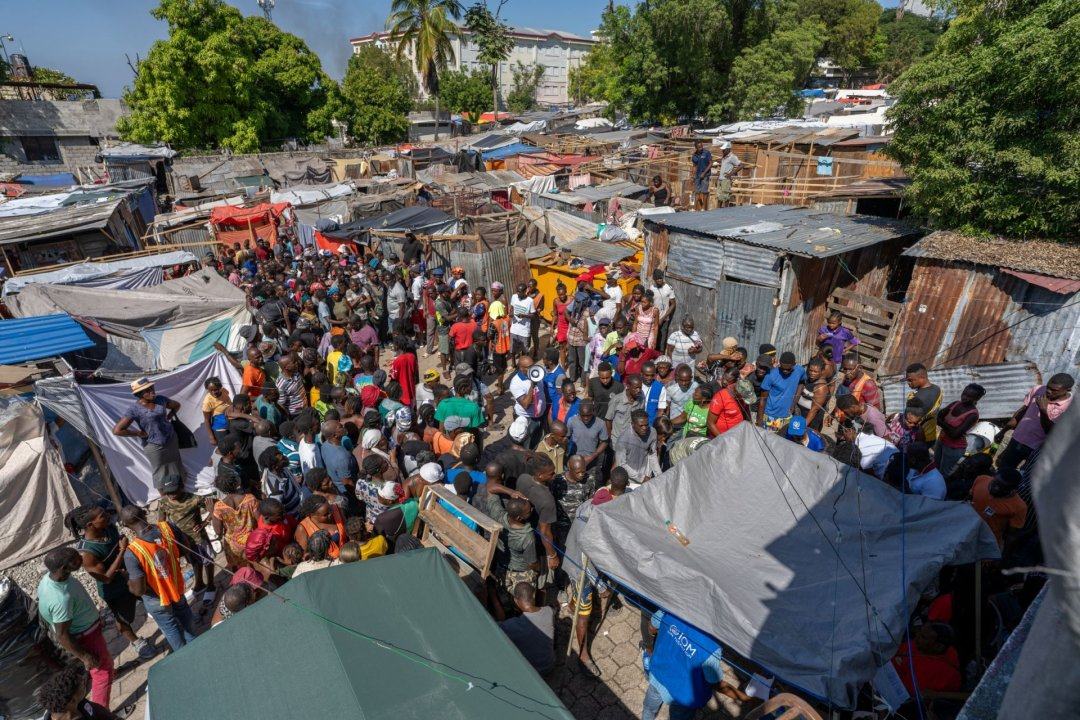
| Opening | A spontaneous displacement site in Haiti | IOM 2024 / Antoine Lemonnier |
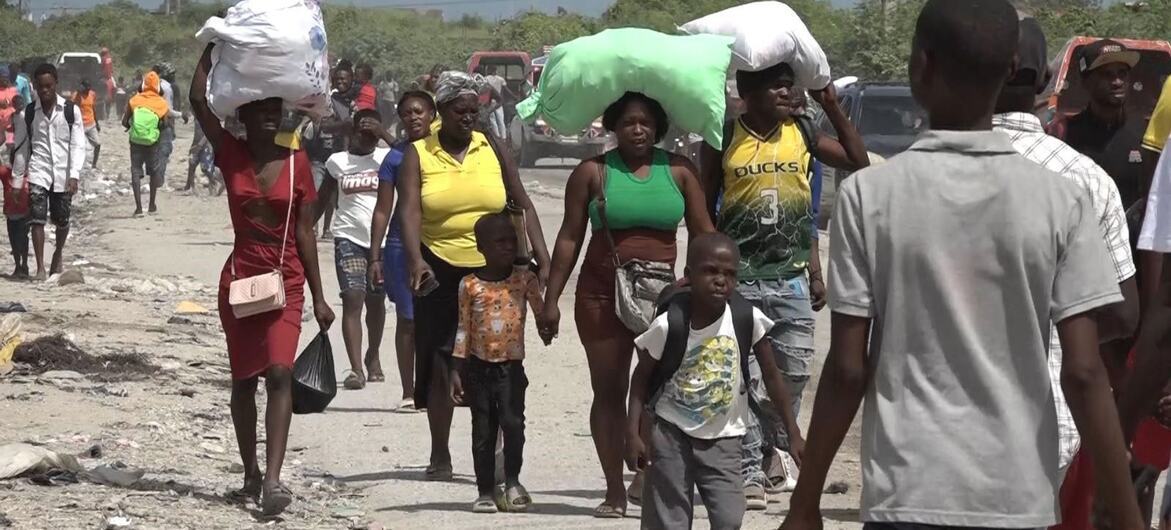
| Chapter 1 | People who have left their homes walk with their belongings through Port-au-Prince | WFP / Odelyn Joseph |
| Chapter 1 | Shelters of displaced people in Cité Soleil, Port-au-Prince | IOM 2026 |
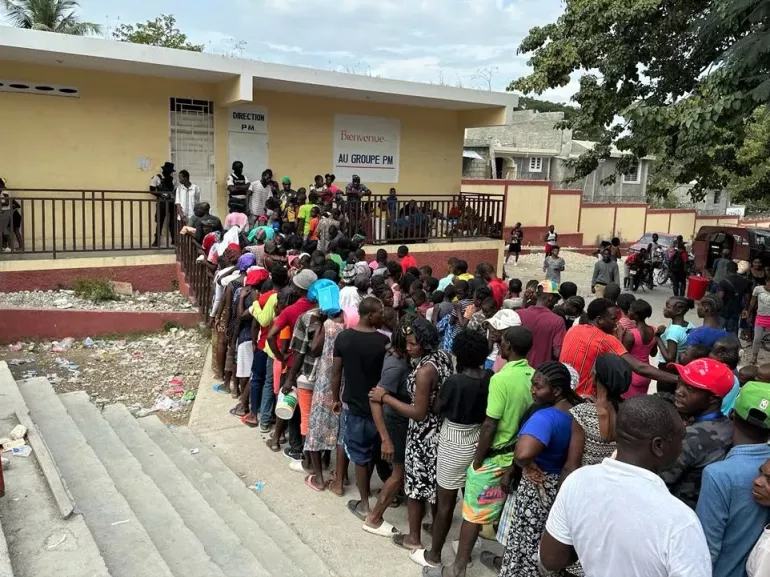
| Chapter 2 | People displaced by the armed-group crisis | UNICEF / Matous |
| Chapter 3 | A building converted into accommodation for displaced families | UNICEF / UNI769396 / Patrice Noel |
Annex III
Methodology and transparency
Scope
Time. From July 2021 to November 2026, with emphasis on 2025 and 2026. Closing date of the investigation: 13 November 2026. Territory. The whole country, with a systematic distinction between the Port-au-Prince metropolitan area and the other departments. No figure for the capital is extrapolated to the whole.
Selection and verification of sources
Priority was given to primary institutional sources: IOM, IPC, BINUH, OHCHR, UNICEF, UNFPA, WHO and PAHO, WFP, OCHA and the World Bank; human rights organisations (Amnesty International, Human Rights Watch); humanitarian organisations (MSF, Mercy Corps, ALIMA); Haitian organisations (GARR, LHDDH, CNSA); peer-reviewed academic literature; and news agency reporting for specific events. Each figure in the text refers to a numbered source with its date of publication, reference period and link. Where a figure was taken from a secondary source, the reference says so (“via”).
Operational definitions
Internally displaced person: according to the DTM, someone who has left their habitual residence and remains in the country; it is a stock figure at a given date, not a flow. Acute food insecurity: population in IPC Phase 3 or above. Victims (BINUH): people killed or injured in incidents verified by the Human Rights Service. Inpatient facility: hospital or centre with beds. Fiscal year: from 1 October to 30 September.
Differences between sources
Six divergences were identified and explained in the text: homicides in 2025 (9,063 against more than 5,915); population in food insecurity (IPC against FEWS NET); cases of gender-based violence (Protection Cluster, BINUH, police and compilations); cholera in 2026 (WHO against the Health Cluster); the weight of remittances in GDP; and the food projection for 2027, which the IPC puts at 6.35 million while an FAO audiovisual piece mentions 6.53 million. In this last case the figure from the IPC technical document is adopted.
Limitations
Under-reporting. All figures on violence, including sexual violence, are minimums. Access to areas under armed-group control is limited and reporting carries risk. Comparability. The indicators come from different periods and should not be combined; the ratios calculated in the conclusion are orders of magnitude. Attribution. BINUH’s percentages by perpetrator do not always add up to one hundred, and the report for the third quarter of 2026 has minor internal inconsistencies between summary and infographic; the figures from the summary and the official press release were used. Access. The data from DTM round 14 and from the IPC analysis of September 2026 come from the official summaries; the full subnational tables had not been published at the time of closing. Gaps. No up-to-date data were found from UNESCO or UN Women, nor on recent maternal mortality, real household income, emigration of health personnel, or series on older people or people with disabilities. The investigation does not use georeferenced event data. Secondary sources. The Human Rights Watch report on drones is cited through news agencies; the extension of the international force’s mandate and the electoral calendar, through press sources.
Sensitive data
No testimonies of survivors of sexual violence are reproduced, nor any data that would allow victims, minors or displaced people to be identified. The scene in the opening comes from an account already published by the United Nations and identifies no minor.
Own calculations
Deaths from January to September 2026: 1,642 + 1,408 + 1,167 = 4,217; injured: 745 + 656 + 459 = 1,860. Price index: 100 × 1.441 × 1.258 × 1.283 × 1.215 = 283. Ratio of displaced people per death: 1,490,000 / 4,217 ≈ 353. Ratio of people in Phase 3 or above per death: 5,940,000 / 4,217 ≈ 1,409. Phase 3 for September 2026: 5.94 − 1.8 = 4.14 million. Displaced population in Ouest: 30% of 1,466,862 ≈ 440,000.
Annex IV
Indicators and data
| Indicator | Value | Reference | Scope | Source |
|---|---|---|---|---|
| Internally displaced people | 1.49 million | Aug. 2026 | National | IOM 2 |
| Displaced people in provinces / capital | 79% / 21% | May 2026 | National | IOM 10 |
| Displaced people outside sites | 84% | May 2026 | National | IOM 10 |
| Returnees | 171,203 | Aug. 2026 | National | IOM 2 |
| Displaced children | 755,000 | Mar. 2026 | National | UNICEF 20 |
| Population in Phase 3 or above | 5.94 million (53%) | Sep. 2026–Feb. 2027 | National | IPC 3 |
| Population in Phase 4 | 1.8 million (16%) | Sep. 2026–Feb. 2027 | National | IPC 3 |
| Projection, Phase 3 or above | 6.35 million (57%) | Mar.–Jun. 2027 | National | IPC 3 |
| Children aged 6 to 59 months with acute malnutrition | 253,725 (93,873 severe) | Jun. 2026–May 2027 | National, estimate | IPC 36 |
| People killed | 1,167 | Jul.–Sep. 2026 | National | BINUH 5 |
| People killed | 5,915 or more | 2025 | National | BINUH 61 |
| Victims in security operations | more than 50% | Jul.–Sep. 2026 | National | BINUH 5 |
| Kidnappings | 137 | Jul.–Sep. 2026 | National | BINUH 5 |
| Extrajudicial executions or attempts | 44 cases | Jul.–Sep. 2026 | National | BINUH 5 |
| Deaths in drone operations | 1,243 (17 children) | Mar. 2025–Jan. 2026 | Ouest | HRW 41 |
| Child recruitment, verified cases | 892 (302 in 2024) | 2025 | National | UNICEF 38 |
| Schools closed | 1,606 | 2024-2025 | National | UNICEF 40 |
| Cases of gender-based violence | 2,888 | Jan.–May 2026 | National | Protection Cluster 38 |
| Operational inpatient facilities | 37 of 100 | 2025 | Port-au-Prince | WHO 49 |
| Cholera cases | 529 (2 deaths) | Jan.–May 2026 | National | WHO 56 |
| Average inflation | 21.5% | fiscal year 2026 | National | World Bank 31 |
| Real GDP | −1.5% (estimate) | fiscal year 2026 | National | World Bank 31 |
| Poverty at 3 dollars a day | 50.8% | 2026 | National | World Bank 31 |
| Deportations from the Dominican Republic | 194,465 | Jan.–Aug. 2026 | National | GARR 19 |
| People in need of assistance | 6.4 million | 2026 | National | OCHA 4 |
| Funding of the humanitarian plan | 49% of USD 880 M | 12 Oct. 2026 | National | OCHA 37 |
Annex V
Sources and links
Numbered in order of appearance. All links were accessed on 12 and 13 November 2026.
- UN News. Back to school in Haiti: ‘Madame, can you stop what the gangs are doing to us?’. Published: 15 Sep. 2026. Data reference: Sep. 2026. news.un.org/en/story/2026/09/1168337
- IOM. DTM Haiti: Report on the internal displacement situation, round 14 (August 2026). Published: 23 Sep. 2026. Data reference: 15 May–12 Aug. 2026. dtm.iom.int/reports/haiti-report-internal-displacement-situation-round
- IPC. Haiti: Acute Food Insecurity Situation September 2026–February 2027 and Projection March–June 2027. Published: Oct. 2026. Data reference: Sep. 2026–Jun. 2027. ipcinfo.org/ipc-country-analysis/details-map/en/c/1165467
- OCHA. Haiti: overview and Humanitarian Needs and Response Plan 2026. Published: Dec. 2025 (updated Nov. 2026). Data reference: 2026. unocha.org/haiti
- BINUH. Quarterly Report on the Human Rights Situation in Haiti, July–September 2026, and press release of 11 November 2026. Published: 11 Nov. 2026. Data reference: 1 Jul.–30 Sep. 2026. binuh.unmissions.org/sites/default/files/2026-11/Q3%202026%20-%20ENGLI
- BINUH. Haiti: At least 1,408 people killed and 656 injured during the second quarter of 2026. Published: 25 Aug. 2026. Data reference: 1 Apr.–30 Jun. 2026. binuh.unmissions.org/en/news/haiti-au-moins-1-408-personnes-tuees-et-6
- BINUH. Haiti: More than 1,600 people killed in the first quarter of 2026. Published: 8 May 2026. Data reference: 1 Jan.–31 Mar. 2026. binuh.unmissions.org/en/press-releases/haiti-more-than-1600-people-kil
- United Nations. Report of the Secretary-General on BINUH, S/2026/325. Published: 14 Apr. 2026. Data reference: Dec. 2025–Feb. 2026 and 2025 annual figures. binuh.unmissions.org/sites/default/files/2026-04/SG%20report%20on%20BI
- Security Council Report. Haiti, April 2026 Monthly Forecast. Published: Apr. 2026. Data reference: Sep. 2025–Mar. 2026. securitycouncilreport.org/monthly-forecast/2026-04/haiti-34.php
- IOM. DTM Haiti: Information sheet on the displacement situation, round 13 (May 2026). Published: 26 May 2026. Data reference: 14 Mar.–17 May 2026. dtm.iom.int/reports/haiti-information-sheet-displacement-situation-rou
- REACH / IOM. Étude de redevabilité dans les sites de déplacés de la ZMPAP (cites DTM of September 2024). Published: 2024. Data reference: Sep. 2024. repository.impact-initiatives.org/document/impact/feebf871/REACH_Facts
- IOM. DTM Haiti: round 11 (September 2025), summary on the DTM portal. Published: Sep.–Oct. 2025. Data reference: Sep. 2025. dtm.iom.int/haiti
- IOM. Haiti’s Displacement Crisis Hits Record 1.5 Million Amid Escalating Violence (press release). Published: 5 Jun. 2026. Data reference: May–Jun. 2026. iom.int/news/haitis-displacement-crisis-hits-record-15-million-amid-es
- PAHO / Health Cluster. Situation report Haiti, Health Cluster, 2nd trimester 2026 (PDF). Published: 15 Jul. 2026. Data reference: Apr.–Jun. 2026. paho.org/sites/default/files/2026/11/situationreport-haiti-healthclust
- CCCM Cluster. Haiti: Country synopsis. Published: 2025. Data reference: Sep.–Oct. 2025. cccmcluster.org/node/278
- OCHA. Haiti, Humanitarian Needs and Response Plan 2026 (humanitarianaction.info). Published: Dec. 2025. Data reference: Jan.–Oct. 2025. humanitarianaction.info/plan/1503/article/haiti-4
- Mercy Corps. Displacement, Gendered Harm, and the Normalization of Crisis in Port-au-Prince, Haiti. Published: 25 Mar. 2026. Data reference: 114 surveys in five sites. mercycorps.org/research-resources/displacement-gendered-harm-and-crisi
- Human Rights Watch. US: Deportations to Haiti Endanger Lives. Published: 21 Sep. 2026. Data reference: Jul.–Sep. 2026. hrw.org/news/2026/09/21/us-deportations-to-haiti-endanger-lives
- GARR (via The Haitian Times). Rights advocates warn mass deportations are worsening Haiti’s humanitarian crisis. Published: 5 Sep. 2026. Data reference: Jan.–Aug. 2026. haitiantimes.com/2026/09/05/haiti-receives-nearly-200000-deportations-
- UNICEF. Haiti Humanitarian Situation Report No. 1. Published: 5 May 2026. Data reference: 1 Jan.–31 Mar. 2026. unicef.org/media/180471/file/Haiti-Humanitarian-Situation-Report-No.1,
- UNFPA. Flash Update on the situation in Haiti (15–27 May 2026). Published: May 2026. Data reference: 15–27 May 2026. unfpa.org/resources/flash-update-situation-haiti-15-27-may-2026
- IOM. DTM Haiti: Study on return dynamics in Bas Delmas and the upper part of Port-au-Prince. Published: 23 Apr. 2026. Data reference: Apr. 2026. dtm.iom.int/reports/haiti-study-return-dynamics-internally-displaced-p
- FEWS NET. Haiti Food Security Outlook, February 2026. Published: Feb. 2026. Data reference: Feb.–Sep. 2026. fews.net/latin-america-and-caribbean/haiti/food-security-outlook/febru
- Cénat, J. M. et al.. Severe psychological distress among internally displaced adults due to armed gang violence in Haiti, Journal of Safety Science and Resilience. Published: 2026. Data reference: survey of 1,545 adults. synapsesocial.com/papers/69a76665badf0bb9e87dcd65
- IPC. Haiti: IPC Acute Food Insecurity Snapshot, September 2026–June 2027 (PDF). Published: Oct. 2026. Data reference: Sep. 2026–Jun. 2027. ipcinfo.org/fileadmin/user_upload/ipcinfo/docs/IPC_Haiti_Acute_Food_In
- IPC. Haiti: Acute Food Security Situation Projection Update for March–June 2026. Published: 16 Apr. 2026. Data reference: Mar.–Jun. 2026. ipcinfo.org/ipc-country-analysis/details-map/en/c/1162842/?iso3=HTI
- IPC. Haiti: Acute Food Insecurity Situation September 2025–February 2026 and Projection March–June 2026. Published: Oct. 2025. Data reference: Sep. 2025–Jun. 2026. ipcinfo.org/ipc-country-analysis/details-map/en/c/1159760/
- IPC. Haiti: Acute Food Insecurity Situation August 2024–February 2025 and Projection March–June 2025. Published: Sep. 2024. Data reference: Aug. 2024–Jun. 2025. ipcinfo.org/ipc-country-analysis/details-map/en/c/1157971/?iso3=HTI
- IPC. IPC Country Analysis: Haiti (historical series of analyses). Published: accessed Nov. 2026. Data reference: 2022–2027. ipcinfo.org/ipc-country-analysis/en/?country=HTI
- CNSA / IPC. Haïti: Analyse IPC de l’insécurité alimentaire aiguë, mise à jour de la projection mars–juin 2026 (full report). Published: Apr. 2026. Data reference: Mar.–Jun. 2026. cnsahaiti.org/Web/Bulletin_IPC/2026/IPC_Haiti_Acute_Food_Insecurity_Pr
- World Bank. Haiti: Overview and Macro Poverty Outlook (October 2026). Published: Oct. 2026. Data reference: fiscal years 2023–2028. worldbank.org/ext/en/country/haiti
- IPC. Haiti: Record displacement and insecurity deepen food crisis (Countries in Focus No. 159). Published: Oct. 2026. Data reference: Sep. 2026–Jun. 2027. ipcinfo.org/ipcinfo-website/countries-in-focus-archive/issue-159/en
- UNFPA. “A point of no return”: An urgent call to support women and girls in Haiti. Published: 2026. Data reference: 2025–2026. unfpa.org/news/%E2%80%9C-point-no-return%E2%80%9D-urgent-call-support-
- Associated Press. Haitians cut back on already scarce food and ask how they’ll survive rising fuel prices. Published: Apr. 2026. Data reference: 2 Apr. 2026. wtop.com/world/2026/04/haitians-cut-back-on-already-scarce-food-and-as
- WFP. WFP Haiti Market Monitoring, March–April 2025. Published: 2025. Data reference: Mar.–Apr. 2025. reliefweb.int/report/haiti/wfp-haiti-market-monitoring-march-april-202
- WFP / UNICEF / FAO. Over a quarter of a million children facing acute malnutrition in Haiti amid ongoing violence. Published: 17 Sep. 2026. Data reference: Jun. 2026–May 2027. wfp.org/news/over-quarter-million-children-facing-acute-malnutrition-h
- OCHA. UN allocates $75 million for life-saving aid to 507 000 people in Haiti. Published: 12 Oct. 2026. Data reference: Oct. 2026. unocha.org/publications/report/haiti/un-allocates-75-million-life-savi
- UNICEF. Haiti Humanitarian Situation Report No. 2 (Mid-Year). Published: 11 Aug. 2026. Data reference: 1 Jan.–30 Jun. 2026. unicef.org/media/183661/file/Haiti-Humanitarian-Situation-Report-No.%2
- UNICEF. Child recruitment in Haiti surges threefold in just one year. Published: 12 Feb. 2026. Data reference: 2025. unicef.org/press-releases/child-recruitment-haiti-surges-threefold-jus
- UNICEF. Humanitarian Action for Children 2026: Haiti. Published: Dec. 2025. Data reference: 2025. unicef.org/media/177171/file/2026-HAC-Haiti.pdf
- Human Rights Watch (via Al Jazeera / AP). Report on drone operations in Haiti. Published: 10 Mar. 2026. Data reference: 1 Mar. 2025–21 Jan. 2026. aljazeera.com/news/2026/3/10/hundreds-killed-in-haiti-drone-strikes-in
- UNICEF. Haiti’s children under siege (statement). Published: Feb. 2025. Data reference: 2024. unicef.org/press-releases/haitis-children-under-siege-staggering-rise-
- Amnesty International. Haiti: Drone attacks raise serious human rights concerns and threaten children. Published: 14 May 2026. Data reference: 2025–2026. amnesty.org/en/latest/news/2026/05/haiti-ataques-con-drones-generan-gr
- BINUH. Quarterly Report on the Human Rights Situation in Haiti, April–June 2025. Published: 2025. Data reference: 1 Apr.–30 Jun. 2025. binuh.unmissions.org/sites/default/files/quarterly_report_on_the_human
- GARR (via The Haitian Times). Group reports 68,000 Haitians deported in early 2026. Published: 13 May 2026. Data reference: Jan.–Mar. 2026. haitiantimes.com/2026/05/13/group-reports-68000-haitians-deported-earl
- UNFPA. Humanitarian Action Overview 2026. Published: Dec. 2025. Data reference: 2025. unfpa.org/sites/default/files/pub-pdf/UNFPA%202026%20Humanitarian%20Ac
- UNFPA. Situation Report on the Crisis in Haiti (January–March 2026). Published: Apr. 2026. Data reference: Jan.–Mar. 2026. unfpa.org/resources/situation-report-crisis-haiti-january-march-2026
- UNFPA. Situation Report on the Crisis in Haiti (July–August 2026). Published: Sep. 2026. Data reference: Jul.–Aug. 2026. unfpa.org/resources/situation-report-crisis-haiti-july-august-2026
- WHO / PAHO. Haiti: WHO Health Emergency Appeal 2026. Published: 3 Feb. 2026. Data reference: 2025. who.int/publications/m/item/haiti--who-health-emergency-appeal-2026
- PAHO. Haiti Humanitarian Crisis – Grade 3 (situation page). Published: n.d. (accessed Nov. 2026). Data reference: no explicit cut-off date. paho.org/en/haiti-humanitarian-crisis-grade-3
- The Haitian Times. Cholera fears rise in Haiti after Hurricane Melissa flooding. Published: 6 Nov. 2025. Data reference: 2025. haitiantimes.com/2025/11/06/cholera-outbreak-haiti-hurricane-melissa/
- WHO. Sustaining essential health services and emergency care amid Haiti’s security crisis (case study). Published: 2025. Data reference: 2024. who.int/countries/country-presence/reports/2025/case-studies/haiti
- Médecins Sans Frontières. MSF supports health services amid violence in Artibonite region. Published: Nov. 2026. Data reference: 2024–2026. prezly.msf.org.uk/msf-haiti-msf-supports-health-services-amid-violence
- PAHO. PAHO’s Health Emergency Appeal 2025: Haiti. Published: Apr. 2025. Data reference: 2024–2025. paho.org/sites/default/files/2025-04/paho-haiti-emergency-appeal-2025.
- PAHO. The fight against cholera in Haiti. Published: Nov. 2025. Data reference: 7 Sep.–9 Nov. 2025. paho.org/en/stories/fight-against-cholera-haiti-communities-government
- WHO. Multi-country outbreak of cholera, Epidemiological Update No. 38. Published: 30 Jun. 2026. Data reference: 1 Jan.–31 May 2026. cdn.who.int/media/docs/default-source/documents/emergencies/situation-
- PAHO / Health Cluster. Humanitarian Situation in Haiti. Bulletin 2 Health Cluster, April–June 2026. Published: Nov. 2026. Data reference: Apr.–Jun. 2026 (cholera as of 18 Jul.). paho.org/en/documents/humanitarian-situation-haiti-bulletin-2-health-c
- Marchetti, M. et al.. Implementing Problem Management Plus (PM+) in Haiti: qualitative study, Cambridge University Press. Published: 7 Apr. 2026. Data reference: review of estimates. cambridge.org/core/product/2F5852F39940AF6438F682D67B5D6707/core-reade
- ALIMA. Armed Violence and Displacement: Haiti’s Mental Health Emergency. Published: 2026. Data reference: 2024–2025. alima.ngo/en/news/on-the-ground/armed-violence-displacement-haitis-men
- OHCHR. Haiti: Over 5,600 killed in gang violence in 2024, UN figures show. Published: 7 Jan. 2025. Data reference: 2023–2024. ohchr.org/en/press-releases/2025/01/haiti-over-5600-killed-gang-violen
- BINUH. Press release on the fourth quarter of 2025 and the annual figures. Published: 30 Jan. 2026. Data reference: 2025. binuh.unmissions.org/en/communiques-de-presse/haiti-la-situation-des-d
- BINUH. Quarterly Report on the Human Rights Situation in Haiti, July–September 2025. Published: Jan. 2026. Data reference: 1 Jul.–30 Sep. 2025. binuh.unmissions.org/sites/default/files/2026-01/Quarterly%20Report%20
- Miami Herald (via Yahoo News). G7 nations issue Haiti statement, warnings as anti-gang operations intensify. Published: 12 Nov. 2026. Data reference: Nov. 2026. yahoo.com/news/world/articles/g7-nations-issue-haiti-statement-1432240
- United Nations Security Council. Resolution 2829 (2026): renewal of the mandate of the Gang Suppression Force until 31 March 2027 (SC/16466). Published: 29 Sep. 2026. Data reference: Sep. 2026. press.un.org/en/2026/sc16466.doc.htm
- World Bank. Haiti Macro Poverty Outlook (October 2025). Published: Oct. 2025. Data reference: fiscal year 2025. haitidocs.org/doc/2026-030-mpo-hti
- LHDDH (via Le Relief Haïti). LHDDH alerts on alarming surge in essential goods prices. Published: 2025. Data reference: 2024–2025. lereliefhaiti.com/en/articles/lhddh-alerts-on-alarming-surge-in-essent
- Associated Press (via Africanews). Haiti: High fuel, food prices pile new pressure on families. Published: 16 Apr. 2026. Data reference: 14 Apr. 2026. africanews.com/amp/2026/04/16/haiti-high-fuel-food-prices-pile-new-pre
- World Bank / IMF. Haiti: Joint World Bank–IMF Debt Sustainability Analysis. Published: 2026. Data reference: fiscal years 2025–2030. documents1.worldbank.org/curated/en/099042026144566919/pdf/BOSIB-4ffbd
- OCHA (via iciHaiti). Launch of the 2026 Humanitarian Response Plan. Published: 18 Dec. 2025. Data reference: 2026. icihaiti.com/en/news-46458-icihaiti-humanitarian-the-un-launches-an-us
- Provisional Electoral Council (compiled on Wikipedia). 2026 Haitian general election: calendar in force; tertiary source, to be checked against the CEP decree. Published: accessed Nov. 2026. Data reference: 2026–2027. en.wikipedia.org/wiki/2026_Haitian_general_election
- CARE. New IPC analysis: 6.35 million Haitians are projected to face acute food insecurity by next year. Published: 29 Oct. 2026. Data reference: Sep. 2026. care.org/media-and-press/new-ipc-analysis-6-35-million-haitians-are-pr
Haiti: life under siege. Special investigation by International Affairs Watch, November 2026. Cartography: departmental boundaries from geoBoundaries (open licence). The figures are minimums documented by the sources cited.